Public anxiety over artificial intelligence has largely centered on apocalyptic scenarios of mass technological unemployment. Yet rigorous empirical research paints a fundamentally different picture: generative AI is functioning primarily as an occupational transformation engine rather than a mass job destroyer. According to the International Labour Organization (ILO) in its comprehensive study Generative AI and Jobs: A Refined Global Index of Occupational Exposure (Working Paper 140), one in four workers worldwide is in an occupation exposed to generative AI.
The ILO’s refined methodology evaluates task-level capabilities across the International Standard Classification of Occupations (ISCO-08). Rather than treating whole professions as monolithic blocks, the agency measured thousands of discrete workplace duties to determine whether generative models can fully automate, augment, or leave tasks untouched. The findings show that while full automation remains concentrated in a narrow slice of the workforce, generative AI job exposure is heavily polarized across national income levels and gender lines. Here are the eight numbers that define the global workplace reality of generative AI.
1. 25%: One in four global workers faces occupational exposure
The foundational benchmark of the ILO’s index is total labor market reach. Worldwide, 25% of global employment falls within occupations that have some potential exposure to generative AI.
This means approximately one in every four workers on earth performs tasks that can be assisted, accelerated, or partially automated by foundation models. However, the ILO emphasizes that exposure does not equal redundancy. Because the vast majority of occupations require interpersonal communication, physical coordination, complex judgment, and contextual decision-making, the primary workplace outcome is job transformation rather than worker displacement.
The updated findings, detailed in the agency’s research brief Generative AI and jobs: A 2025 update, indicate that the nature of work is evolving fastest where knowledge tasks can be broken into structured prompts and digital outputs. In parallel with our examination of labor market impacts on entry-level jobs, the challenge for organizations lies in restructuring apprenticeship models, ensuring junior employees master foundational cognitive skills even as routine drafting is absorbed by software.
2. 34% vs 11%: The stark income divide between rich and poor nations
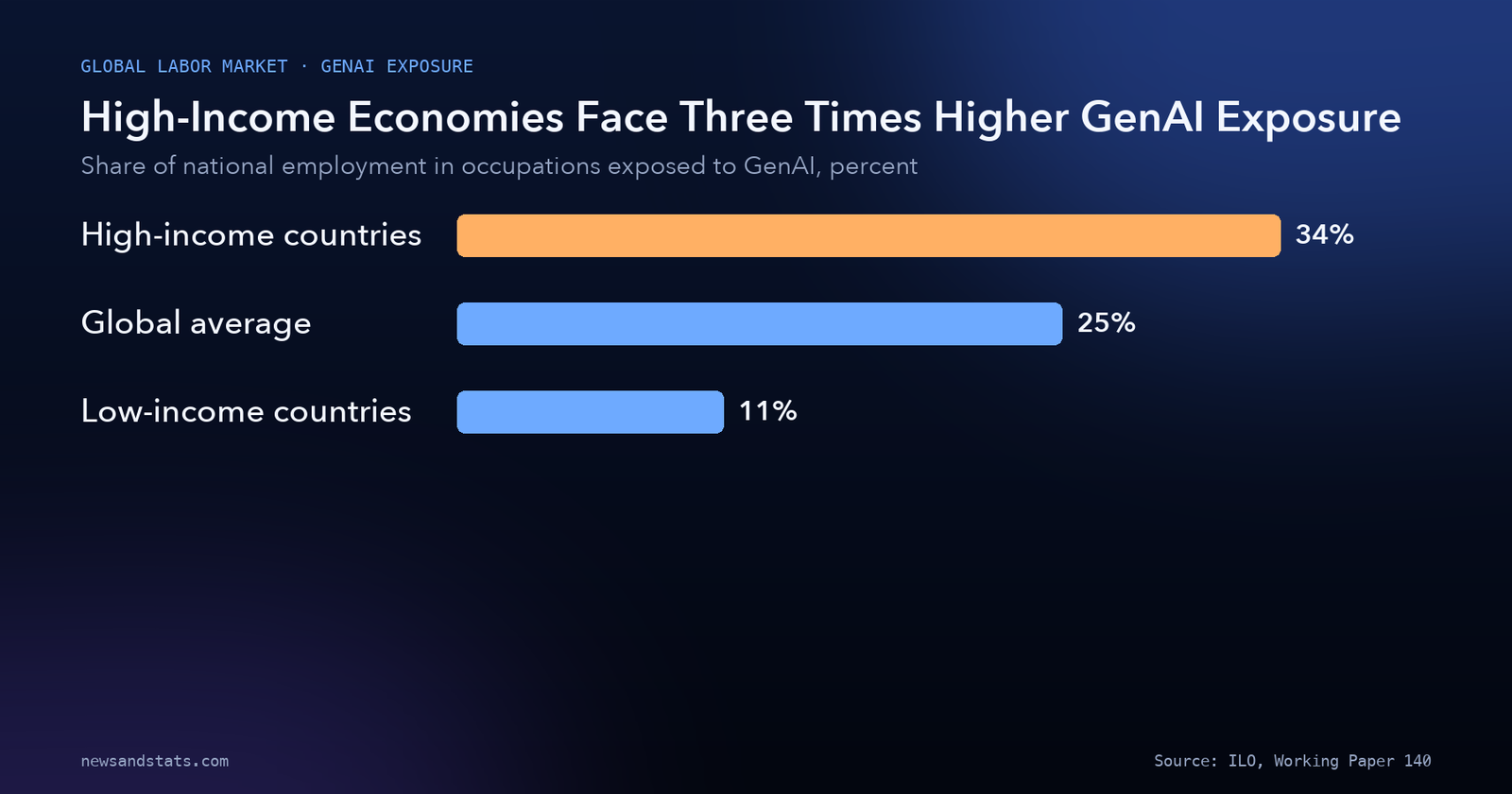
Occupational exposure to generative AI is intensely concentrated in the developed world. In high-income countries (HICs), 34% of total employment falls within occupations exposed to generative AI. In low-income countries (LICs), that exposure figure drops to just 11%.
Our calculation: workers in high-income economies face more than three times the rate of generative AI exposure as workers in low-income economies (34% divided by 11% is 3.09).
Source: ILO, Working Paper 140.
This 23 percentage point disparity reflects the underlying economic structure of national workforces. High-income economies are characterized by large service sectors, widespread financial digitization, and deep concentrations of corporate, legal, and software professionals. In low-income nations, the labor market remains heavily anchored in agriculture, physical resource extraction, informal commerce, and manual construction—tasks that generative models cannot execute.
This technological insulation in developing nations, however, comes at an economic cost. While workers in low-income countries face less immediate automation pressure, their economies risk missing out on the substantial productivity dividends generated by cognitive augmentation. Digital infrastructure disparities, power availability constraints, and localized compute shortages threaten to widen the productivity gap between advanced economies and the Global South.
3. 3.3%: The narrow boundary of high-risk full automation
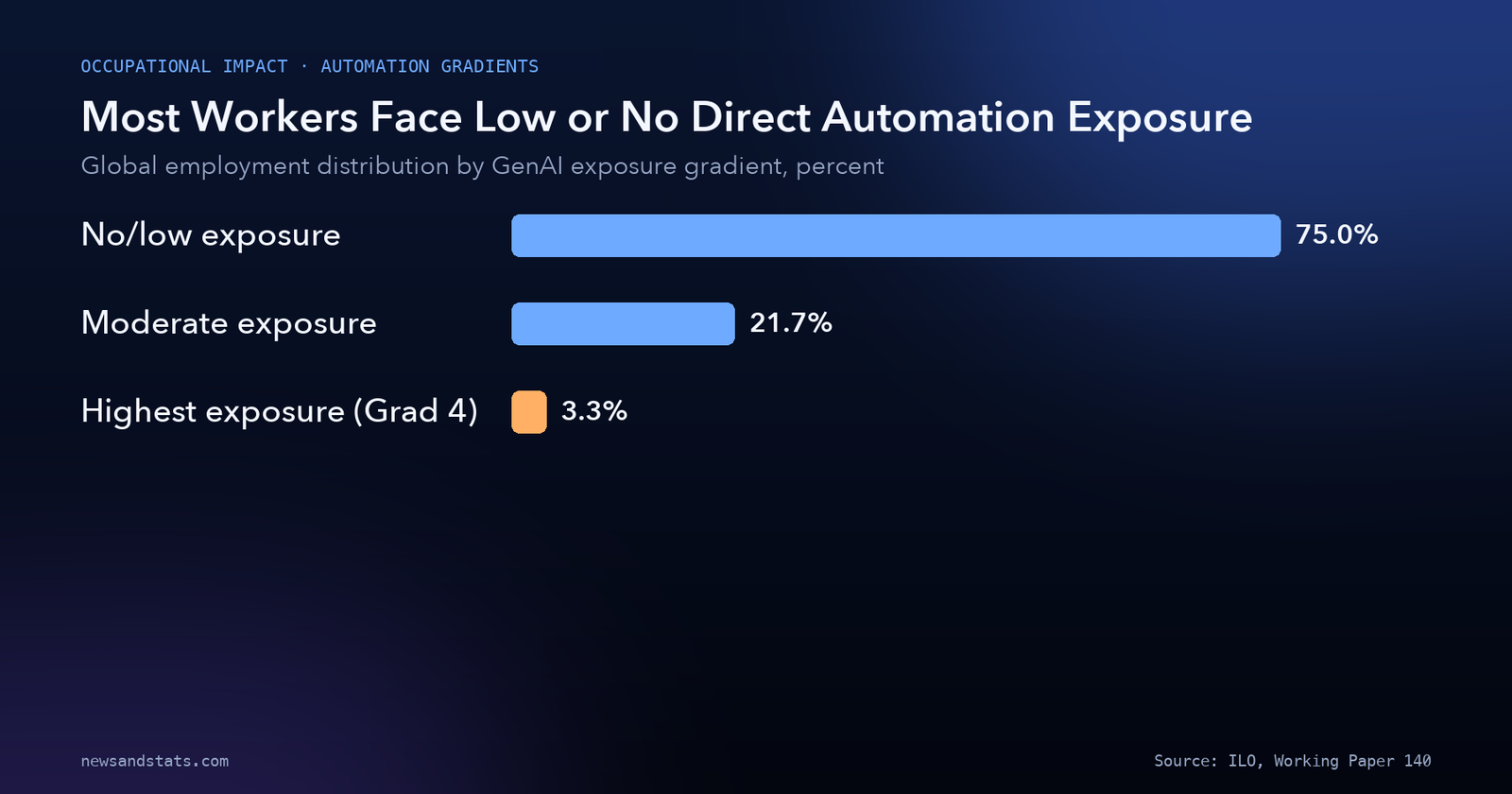
While one-quarter of the global workforce experiences some exposure, the segment facing outright technological displacement is modest. According to the ILO index, only 3.3% of global employment falls into Gradient 4, the highest exposure tier where tasks have high theoretical potential for complete automation.
The ILO framework establishes four distinct exposure gradients based on mean automation scores and task variability:
- Gradient 1: Low or negligible exposure (manual, physical, and trades work).
- Gradient 2: Low-to-moderate exposure (routine tasks with heavy human interaction).
- Gradient 3: Moderate-to-high exposure (cognitive tasks where AI augments professionals).
- Gradient 4: Highest exposure (structured digital processing and repetitive data manipulation).
Source: ILO, Working Paper 140.
Our calculation: combining unexposed workers (75.0%) and moderately exposed workers (21.7%) reveals that 96.7% of the global labor force sits outside the severe displacement zone.
The reality that only 3.3% of global jobs are severely vulnerable disproves broad claims of rapid labor obsolescence. Instead of mass job elimination, the overwhelming majority of workers in exposed categories (occupying Gradients 2 and 3) will see their daily task mixtures reorganized. Physical production tools also operate under different constraints; as examined in our coverage of physical factory robotics and automated machinery, capital expenditure cycles, mechanical installation bottlenecks, and safety regulations create natural multi-year absorption barriers.
4. 4.7% vs 2.4%: The global gender exposure gap
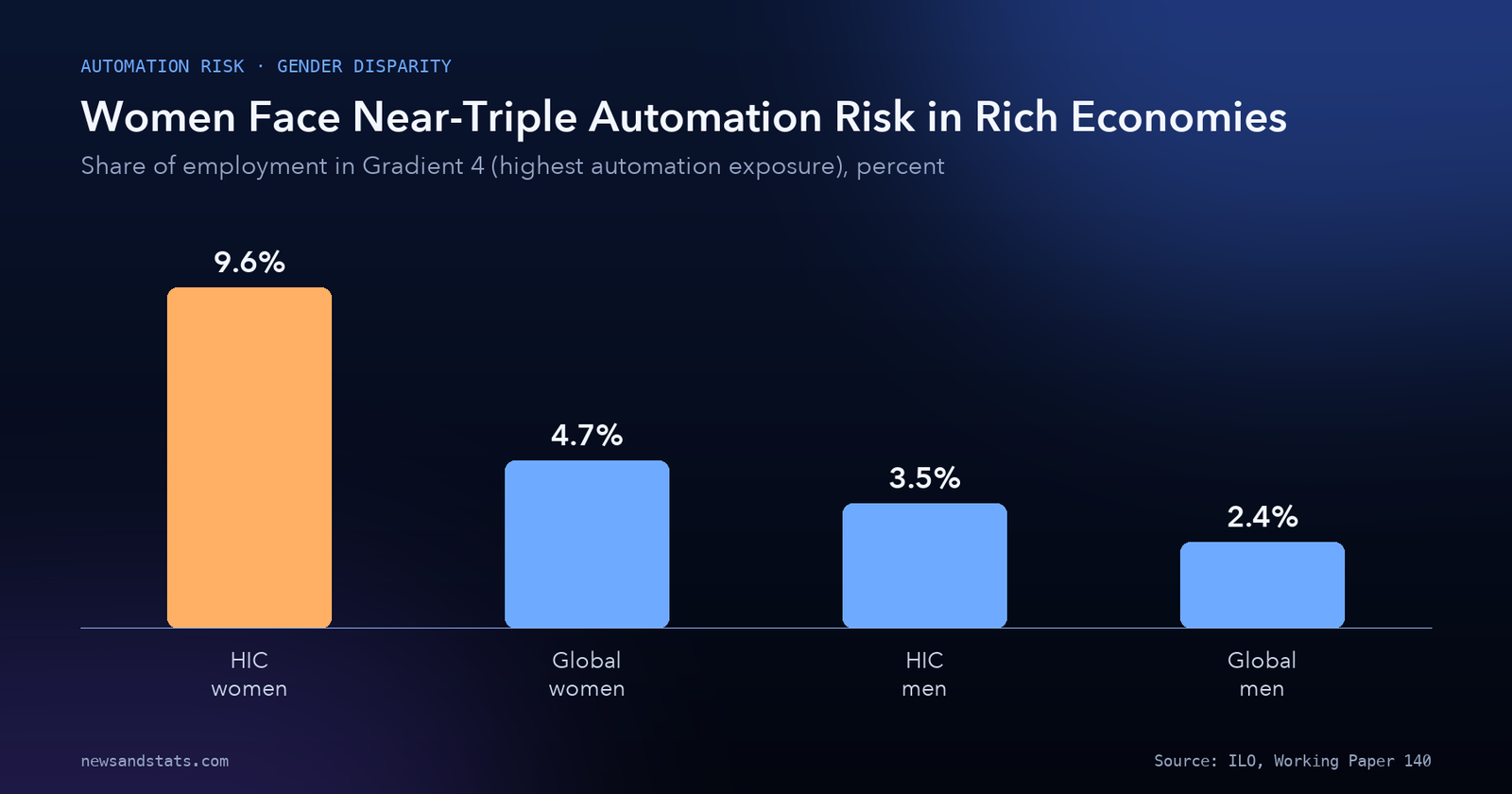
The most significant structural inequality uncovered by the ILO’s index is demographic: women face nearly double the automation risk of men. On a global scale, 4.7% of female employment falls into Gradient 4 (the highest automation risk category), compared with just 2.4% of male employment.
Our calculation: female employment is 1.96 times more exposed to high-risk automation than male employment globally.
This gap is a direct consequence of persistent occupational segregation. Worldwide, women comprise a disproportionate share of clerical support workers, customer service representatives, data entry operators, and administrative assistants. These occupations feature high volumes of structured text generation, scheduling, and standard customer communication—the precise capabilities where generative AI tools perform with the greatest competence.
By contrast, male employment remains disproportionately concentrated in physical trades, transportation, industrial machine operation, construction, and agricultural labor, where current AI models have virtually zero direct substitution capacity. Consequently, unmanaged enterprise AI rollouts risk disproportionately displacing female workers while male-dominated manual occupations remain insulated.
5. 9.6% vs 3.5%: The threefold gender disparity in advanced economies
When gender disparities are evaluated within high-income countries, the gap expands dramatically. In high-income nations, jobs in the highest automation exposure category (Gradient 4) account for 9.6% of all female employment, compared to just 3.5% of male employment.
Our calculation: in advanced economies, female workers are 2.74 times more likely to hold jobs in the highest automation exposure tier than their male counterparts. Nearly one in ten working women in wealthy nations occupies a role highly vulnerable to task automation.
Source: ILO, Working Paper 140.
The 6.1 percentage point gulf in advanced economies highlights how white-collar service deskilling intersects with gender equity. Over past decades, corporate back-offices, legal secretarial pools, human resources screening, and insurance claims processing served as major pathways for female labor force participation and middle-class income mobility in North America and Western Europe.
As corporations deploy automated workflow tools to reduce overhead, these traditional administrative roles face structural contraction. As explored in our comparative analysis of the economic gap between India and China, national economic transitions depend heavily on how effectively female labor force participation is redirected toward technical, supervisory, and high-value service functions.
6. 0.29: The global mean automation score stabilizes
A critical methodological revelation of the ILO’s 2025 assessment is that overall task automation scores have stabilized rather than escalated exponentially. The global mean automation score across all occupations was measured at 0.29 in 2025 (on a standardized scale from 0 to 1), compared to 0.30 in the ILO’s initial 2023 index.
While the mean score remained essentially unchanged (dropping slightly from 0.30 to 0.29), the dispersion of scores narrowed significantly. The standard deviation of task scores fell by more than half, dropping from 0.30 in 2023 to 0.14 in 2025.
Our calculation: the standard deviation contracted by 53.3%, indicating that evaluations of AI capabilities have matured from early speculative extremes into a tight, realistic consensus among workplace practitioners.
In 2023, initial assessments exhibited extreme variance: some analysts assumed AI could automate virtually every cognitive duty, while others dismissed its utility entirely. By 2025, empirical evaluations across thousands of workplace tasks converged. Generative models excel at discrete sub-tasks—such as summarizing documents, drafting routine email responses, extracting data from invoices, and generating boilerplate software code—but struggle with contextual ambiguity, negotiation, and physical execution.
This score stabilization demonstrates that the technological boundary of generative AI is becoming well understood. The narrative of an omnipotent technology replacing all cognitive work in a single leap has given way to granular operational engineering, where software augments specific workflows while human oversight remains mandatory.
7. 52,558 data points across 2,861 tasks: The empirical foundation
The credibility of the ILO’s findings rests on unprecedented empirical granularity. To construct the refined index, researchers evaluated 52,558 distinct data points regarding the perceived automation potential of 2,861 separate workplace tasks.
The research framework, published in collaboration with NASK (Poland’s National Research Institute), drew upon a representative sample of 29,753 tasks cataloged within occupational documentation. The study surveyed 1,640 active workers across all 1-digit ISCO-08 occupational categories and subjected the findings to multiple rounds of Delphi-style expert panels involving international labor economists and computer scientists.
Using this repository of human-verified evaluations, the authors trained a specialized AI assistant capable of predicting automation and augmentation scores across the full technical documentation of ISCO-08. This dual-layer approach—anchoring algorithmic predictions in verified human workplace experience—prevents the wild exaggerations common in pure model self-evaluations.
The computational demands of training and serving these analytical models reflect broader industrial trends. As documented in our examination of power grid bottlenecks and infrastructure constraints and advanced compute and memory hardware bottlenecks, scaling artificial intelligence systems across enterprise workflows is governed by physical power availability, server manufacturing, and high-bandwidth memory supplies.
8. Clerical work: The epicenter of occupational restructuring
Across every geographic region and income tier, clerical occupations consistently exhibit the highest exposure to generative AI. Under the ISCO-08 taxonomy, clerical support workers (Major Group 4)—including general office clerks, secretaries, bank tellers, data entry personnel, and contact center agents—register exposure levels far exceeding any other group.
The ILO’s findings are confirmed in its official announcement, titled One in four jobs at risk of being transformed by GenAI, new ILO–NASK Global Index shows. The report highlights that clerical occupations face intense exposure because up to 85% of their daily constituent tasks can theoretically be augmented or automated by language and document models.
However, the report notes an important emerging trend: strongly digitized cognitive professions are now seeing increased exposure scores. Advances in multimodal models—encompassing synthetic voice generation, automated image synthesis, and high-level coding assistance—have elevated exposure scores for tasks within media, graphic design, translation, financial analysis, and software development.
The critical distinction lies in occupational resilience. Software developers and financial analysts possess high digital literacy and complementary skills, enabling them to absorb AI tools to increase output and capture wage premiums. Clerical workers, by contrast, often possess narrower task scopes and fewer opportunities to pivot into strategic roles, making them far more vulnerable to organizational headcount freezes.
How to read the ILO occupational exposure index
Navigating occupational exposure metrics requires understanding five essential analytical principles:
- Exposure is not employment loss. An exposure score measures the proportion of tasks within an occupation that generative AI can perform or assist. In most roles, AI automates repetitive administrative duties, freeing workers to concentrate on higher-value interpersonal, analytical, or strategic tasks.
- Occupations are bundles of diverse tasks. A job title like “medical secretary” involves scheduling (high automation potential), patient greeting (low automation potential), and emergency triage coordination (zero automation potential). Measuring exposure at the task level prevents overstating net job destruction.
- Task feasibility differs from enterprise adoption. A model may possess the technical capability to draft legal contracts, but enterprise adoption depends on software licensing costs, regulatory compliance, data privacy liability, and institutional inertia.
- Income tiers reflect structural composition, not worker skill. High-income nations register 34% exposure because their economies are dominated by service and knowledge sectors. Low-income nations register 11% exposure because agriculture and manual labor represent the bulk of domestic employment.
- Gradients delineate augmentation from replacement. Gradients 2 and 3 represent occupational augmentation, where human workers use AI as a cognitive productivity amplifier. Only Gradient 4 represents a severe automation profile where human involvement is significantly diminished.
The global generative AI occupational exposure landscape at a glance
The following table summarizes the primary metrics established in the ILO’s 2025 Global Index of Occupational Exposure across workforce reach, national income divides, demographic disparities, and empirical research parameters.
| Metric | Measured value | Reference baseline | Key demographic or institutional driver | Source |
|---|---|---|---|---|
| Global workforce with GenAI exposure | 25% (one in four) | Global employment | Task-level cognitive augmentation across all sectors | ILO Working Paper 140 |
| High-income countries exposure share | 34% of employment | Service economy | Deep digitization in finance, legal, and administration | ILO Working Paper 140 |
| Low-income countries exposure share | 11% of employment | Primary sector | Workforce concentrated in agriculture and manual trades | ILO Working Paper 140 |
| Global workforce in Gradient 4 (highest risk) | 3.3% of employment | Displacement tier | Confirms transformation dominates over destruction | ILO Working Paper 140 |
| Female employment in Gradient 4 (global) | 4.7% of women | Gender disparity | Overrepresentation in clerical and administrative roles | ILO Working Paper 140 |
| Male employment in Gradient 4 (global) | 2.4% of men | Gender disparity | Heavy concentration in manual, trade, and transport roles | ILO Working Paper 140 |
| Female employment in Gradient 4 (HICs) | 9.6% of women | Advanced nations | Nearly triple the automation exposure rate of men | ILO Working Paper 140 |
| Male employment in Gradient 4 (HICs) | 3.5% of men | Advanced nations | Insulated by professional leadership and manual roles | ILO Working Paper 140 |
| Global mean automation score | 0.29 (scale 0-1) | 0.30 in 2023 | Empirical stabilization of technical capabilities | ILO Research Brief 2025 |
| Automation score standard deviation | 0.14 in 2025 | 0.30 in 2023 | Consensus replaces early speculative volatility | ILO Research Brief 2025 |
| Empirical task evaluations collected | 52,558 data points | 2,861 tasks | Representative survey across 1,640 active workers | ILO Working Paper 140 |
| Total occupational tasks cataloged | 29,753 tasks | Polish system | Comprehensive empirical classification baseline | ILO Working Paper 140 |
Sources: ILO, Generative AI and Jobs: A Refined Global Index of Occupational Exposure and ILO Research Brief.
What to watch
- Whether high-income economies initiate dedicated retraining programs targeting clerical and administrative workers to avert structural female unemployment.
- The diffusion rate of multimodal and voice-enabled AI agents into customer service and translation centers across major business process outsourcing (BPO) hubs.
- The evolution of enterprise hiring patterns for entry-level cognitive roles in corporate finance, legal research, and software engineering.
- Whether low- and middle-income nations expand digital infrastructure to capture productivity gains from cognitive augmentation before the global technological divide widens.
- The emergence of collective bargaining frameworks and social dialogue agreements addressing AI-driven workplace monitoring and task restructuring.
- The next iteration of the ILO-NASK Global Index, monitoring whether agentic AI architectures shift exposure scores in managerial and technical occupations.
The bottom line
The global reality of generative AI at work is defined by transformation, not obsolescence: while one in four workers worldwide faces occupational exposure, only 3.3% of the global labor force sits in the high-risk automation tier. The profound challenge lies in structural distribution: high-income nations face more than three times the exposure of developing economies, and women face nearly triple the automation risk of men in advanced economies due to clerical concentration. As the global mean automation score stabilizes at 0.29, the policy imperative must shift from resisting technological progress toward managing workplace transitions through proactive reskilling and social dialogue. For the broader macroeconomic environment shaping global labor markets, explore our macroeconomic environment from the IMF, and visit our AI & Work section for continuing analysis of the modern workplace.
Related reading
- Is AI hurting entry-level jobs? Two studies, two answers: an empirical investigation into junior tech hiring and career formation.
- Five Million Robots in Factories: The Global Automation Surge in 8 Numbers: physical robotics, operational factory fleets, and global manufacturing density.
- India vs China: the economic gap in 10 numbers: demographics, industrial capacity, and economic growth compared.