As the United Nations’ COP31 climate summit meets in Antalya, Türkiye, from 9 to 20 November 2026, the scientists who track the planet’s CO2 output released their own verdict on the year: the Global Carbon Budget 2026. It is a mixed one. Fossil fuel CO2 emissions are projected to fall 0.4% in 2026, to 38.2 billion tonnes — the first annual dip since the pandemic year of 2020. Add in emissions from deforestation and other land-use change, though, and total CO2 is set to reach a record 43.3 billion tonnes, up from 42.8 billion tonnes in 2025. Pierre Friedlingstein, the University of Exeter professor who led the study, put it plainly in the University of East Anglia’s own account of the report: “A reduction driven partly by geopolitical shocks is not a sustainable climate solution.” Here is what the numbers actually show.
The Global Carbon Budget 2026, in one dip
Every November, the Global Carbon Project — a consortium of more than 90 research institutions led by the University of Exeter, the University of East Anglia (UEA), Norway’s CICERO and Germany’s LMU Munich, among others — publishes the Global Carbon Budget: the most complete annual accounting of how much CO2 humanity has added to the atmosphere, and how much room is left before the planet crosses agreed warming limits. The 2026 edition, posted as a preprint in the journal Earth System Science Data on 10 November 2026, projects global fossil CO2 emissions of 38.2 billion tonnes for the year, down 0.4% from 2025, with a margin of roughly -1.5% to +0.6% since the year is not yet over. That is a real, if small, break from a decade in which total CO2 emissions grew just 0.3% a year on average — itself a sharp slowdown from 1.7% a year in the decade before. But a single year’s dip is not the same as a turning point, and the report’s own authors are explicit that this one was not driven by the kind of structural change — a sustained shift away from fossil fuels — that would make it last.
Why fossil CO2 fell: a war, not a turnaround
The entire fossil-fuel dip traces back to one source: oil. Oil-related CO2 fell an estimated 1.9% in 2026, by far the largest single driver of the overall decrease. Coal rose an estimated 0.6%, and natural gas barely moved, down just 0.3%. Neither of those follows the pattern of a world moving steadily off fossil fuels; both follow the pattern of volatile energy markets in a year scarred by conflict. The reason oil fell is not demand destruction from clean alternatives — it is the same shock News & Stats has already quantified in the 2026 energy shock: the Iran conflict and the closure of the Strait of Hormuz, which pushed up oil prices and cut into fuel use worldwide. Global shipping also rerouted trade away from the Strait of Hormuz for much of the year, adding further friction to oil-dependent transport. Glen Peters, a research professor at the CICERO Center for International Climate Research and one of the report’s co-authors, drew the line clearly: a one-year drop in emissions, he said, “is not a peak unless it is driven by structural change.” If the conflict eases and oil prices fall back, 2027’s emissions could just as easily climb again.
India is the only major emitter still rising
Behind the global average, the national picture is split almost everywhere except one country, according to the University of Exeter’s own summary of the report. China, the largest single source at an estimated 32% of global fossil CO2, is projected to fall 0.9% in 2026, with its own coal use rising just 0.3%. The United States, at roughly 13% of the global total, is projected down 1.3%. The European Union, at about 6%, is projected down 1.5%, and Japan, at about 2.5%, down 1.0%. The rest of the world combined, excluding those four plus India, is projected down 0.7%.
India is the exception. At roughly 8% of global fossil CO2, India’s emissions are projected to rise 4.4% in 2026 — faster than its own 3.5% average annual growth over the past decade, and the only increase among the world’s largest emitters. That single number does most of the work of keeping the global total from falling further, and it is a reminder that even in a year when the headline trend is “down,” the world’s fastest-growing large economy is still adding more fossil CO2, not less. None of this happens in a vacuum: energy costs that rattled the World Bank’s own commodity outlook this year pushed against every importing economy, including India’s, even as its coal-fired power use kept climbing.
| Region | Share of global fossil CO2 (2026, projected) | Change vs 2025 |
|---|---|---|
| China | 32% | -0.9% |
| United States | 13% | -1.3% |
| India | 8% | +4.4% |
| European Union | 6% | -1.5% |
| Japan | 2.5% | -1.0% |
| Rest of world | 38% | -0.7% |
Source: Global Carbon Budget 2026 (Friedlingstein et al.), Earth System Science Data preprint; shares as reported by the source and rounded, so they do not sum to an exact total.

Source: Global Carbon Budget 2026 (Friedlingstein et al.), Earth System Science Data preprint.
A record 43.3 billion tonnes, driven by land, not fuel
Fossil fuels are only part of the carbon ledger. The Global Carbon Budget 2026 also tracks emissions from land-use change — mainly deforestation — and this is where 2026’s record comes from. Land-use CO2 is projected to rise to 5.1 billion tonnes in 2026, up from an estimated 4.4 billion tonnes in 2025 and above the 2016-2025 average of 4.9 billion tonnes a year. Add that to the 38.2 billion tonnes of fossil CO2, and total emissions reach 43.3 billion tonnes — a new high, even though the fossil half of the ledger fell. Had land-use emissions simply stayed at 2025’s level, total CO2 would have come in essentially flat for the year instead of setting a record. It is a reminder that a “down” headline on fossil fuels can still sit inside an “up” headline overall, depending on what else moved.
The 1.5°C carbon budget: under four years left
The report’s most consequential number may be the one about the future rather than the past. As of the start of 2027, the Global Carbon Budget 2026 estimates that the world can still emit about 150 billion tonnes of CO2 and keep a 50% chance of holding warming to 1.5°C above pre-industrial levels — equivalent to less than four years of emissions at the current rate. The budgets for higher thresholds are larger but still finite: 510 billion tonnes for 1.7°C, about 12 years at current emissions, and 1,035 billion tonnes for 2°C, about 24 years. Those figures move every year, and not always in the direction headlines suggest: a slightly smaller annual emissions total, as 2026 produced, still eats into a budget that does not grow back. Friedlingstein’s own framing of the report captures the tension: fossil emissions can dip for reasons that have nothing to do with climate policy, while the finite budget for 1.5°C keeps shrinking regardless.

Source: Global Carbon Budget 2026 (Friedlingstein et al.), Earth System Science Data preprint.
427.7 parts per million, and still climbing
All of this shows up directly in the atmosphere. Average atmospheric CO2 concentration is projected to reach 427.7 parts per million (ppm) in 2026, a rise of about 2.2 ppm over the year and 54% above the pre-industrial level of roughly 278 ppm in 1750. That followed an average of 425.6 ppm in 2025. The reason the atmospheric total keeps climbing even when annual emissions wobble is that natural “sinks” only absorb part of what humanity emits. Over 2016-2025, the world’s oceans absorbed an average of about 3.0 billion tonnes of carbon a year — roughly 11.0 billion tonnes of CO2 — and land ecosystems absorbed about 2.5 billion tonnes of carbon a year, or roughly 9.2 billion tonnes of CO2, leaving the remainder to accumulate in the air. Human-caused warming, the report notes, had already reached 1.37°C above the 1850-1900 average by 2025.
Solar, wind and EVs are finally bending the curve
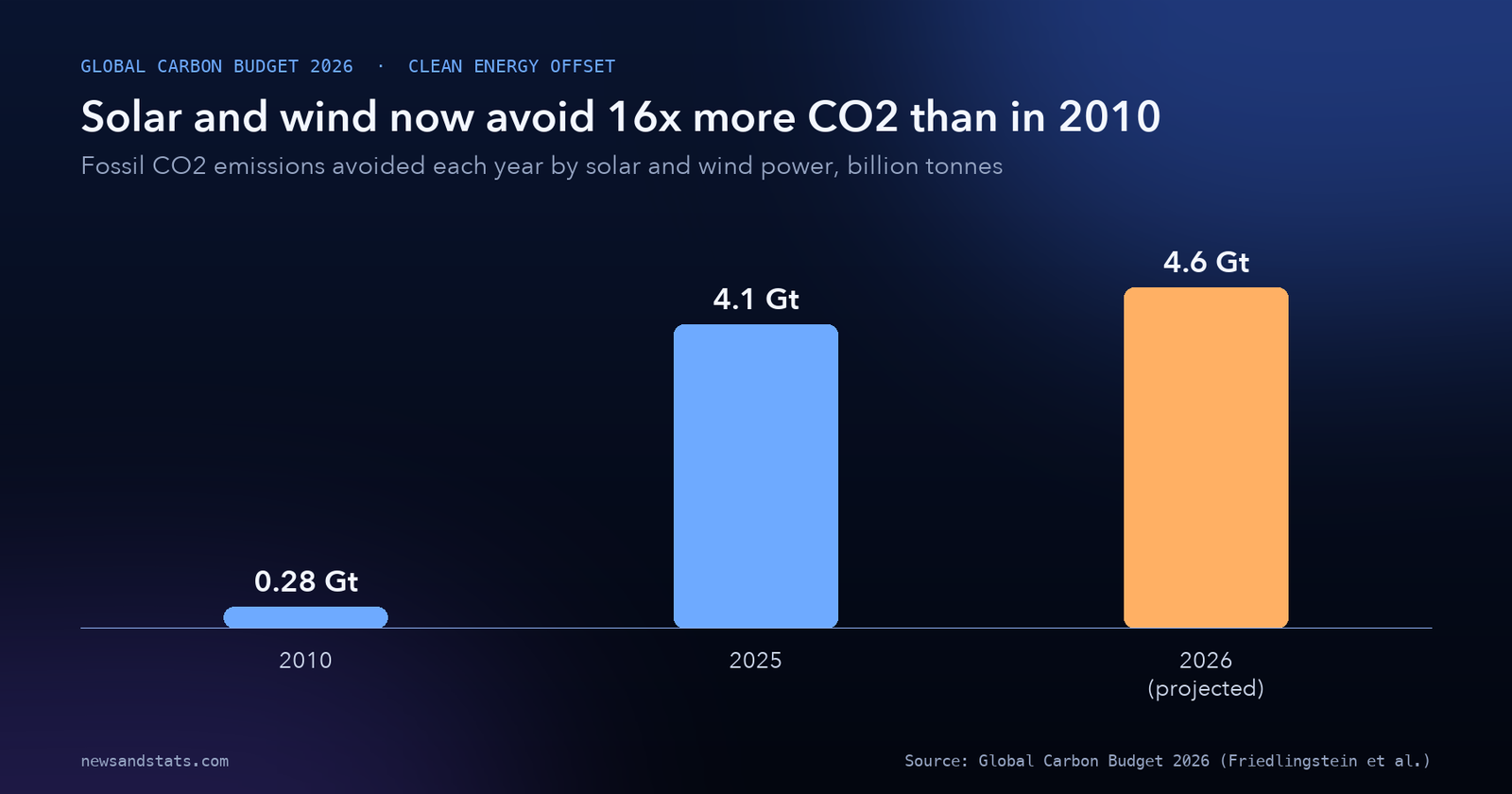
The one genuinely encouraging trend in the report is how fast clean technology is growing — even if it is not yet enough to flip the fossil numbers negative on its own. Solar and wind power avoided an estimated 4.1 billion tonnes of fossil CO2 emissions in 2025 and are projected to avoid 4.6 billion tonnes in 2026, up from just 0.28 billion tonnes in 2010 — more than 16 times as much. That growth builds directly on solar PV’s record year and on the IEA’s renewables forecast, both of which News & Stats has covered separately this month. Corinne Le Quéré, a Royal Society Research Professor at UEA’s School of Environmental Sciences and one of the report’s authors, said the shift is visible in the data: “Clean technologies are making a real difference in reducing global emissions.” Electric vehicles are adding to that effect — about 10% of the global car fleet was electrified by 2025 (6% excluding hybrids), a trend reflected in this year’s surge in global electric car sales. The report also found that 59 countries cut their fossil CO2 emissions in 2025 while still growing their economies, compared with 2019 — evidence that emissions and growth can separate, even if they have not yet separated for the world as a whole.
Source: Global Carbon Budget 2026 (Friedlingstein et al.), Earth System Science Data preprint.
How a scientific dip gets misread
A small, war-driven fall in fossil CO2 is easy to misread as proof that the climate problem is solving itself. The report’s own authors went out of their way to head that reading off. Julia Pongratz, of LMU Munich’s Department of Geography and one of the study’s co-authors, said: “We need to act on all these fronts now.” The data back up her caution in a specific way: engineered carbon dioxide removal — technology built to pull CO2 directly out of the air — is still so small a factor that, according to the report, it offsets less than 30 minutes of the world’s annual fossil CO2 emissions. That is not a rounding error in the budget; it is close to zero. The 0.4% fall in fossil CO2 this year came almost entirely from one fuel, in one set of countries, for reasons tied to a conflict rather than a policy choice or a technology breakout. None of the three co-authors quoted in the report describe 2026 as a turning point, and the data, taken on their own terms, do not show one either.
COP31 meets in Antalya as the data lands
The timing is not an accident. COP31, the UN’s 31st climate conference, is being held in Antalya, Türkiye, from 9 to 20 November 2026, under a joint presidency shared by Türkiye and Australia — the first time two countries have formally shared a COP presidency in this way. The Global Carbon Budget 2026 was released in the same window, as it has been timed to coincide with the UN climate conference in recent years, putting the year’s hard emissions numbers directly in front of the negotiators meeting to discuss what comes next. Whatever is agreed in Antalya, the numbers in this report describe what already happened in 2026, not what might happen as a result of this month’s talks — a distinction worth keeping in mind when the summit’s own announcements start to circulate.
What to watch
- Whether 2027’s fossil CO2 figure rises back above 2025’s level once oil markets settle, which would confirm that 2026’s dip was conflict-driven rather than structural.
- India’s 2027 emissions growth rate against its 3.5% decade average — a repeat of 2026’s 4.4% jump would make it a two-year pattern rather than a one-off.
- Whether land-use CO2 emissions fall back toward the 2016-2025 average of 4.9 billion tonnes a year, or stay elevated, which would keep total CO2 at record levels even if fossil CO2 keeps falling.
- The atmospheric CO2 reading for 2027: another annual rise close to 2.2 ppm would mean the slowdown in fossil emissions has not yet shown up in the air itself.
- Any outcomes from COP31 in Antalya that reference this report’s figures directly, which would be the clearest sign the data are shaping the negotiations rather than just accompanying them.
The bottom line
The Global Carbon Budget 2026 is a report about a small decline wrapped around a bigger record. Fossil fuel CO2 fell 0.4%, but only because an oil shock tied to the Iran conflict and the Strait of Hormuz cut into fuel use, while coal kept rising and gas barely moved. Add emissions from land-use change, and total CO2 hit a record 43.3 billion tonnes. The remaining carbon budget for 1.5°C of warming is now down to about 150 billion tonnes, or under four years at the current emissions rate. Clean energy is growing fast enough to matter, avoiding 4.6 billion tonnes of CO2 in 2026 alone, but not yet fast enough to turn the fossil-fuel trend line down on its own.
Related reading
- Who pays for the 2026 energy shock? The numbers, country by country: the economic bill for the same Strait of Hormuz shock that helped push 2026’s oil emissions down.
- Solar Electricity Generation in 8 Numbers: How Solar PV Met One-Quarter of World Energy Growth: the clean-energy growth now offsetting a meaningful share of rising global energy demand.
- Global Electric Car Sales in 8 Numbers: the vehicle shift chipping away at oil demand from the other direction.