
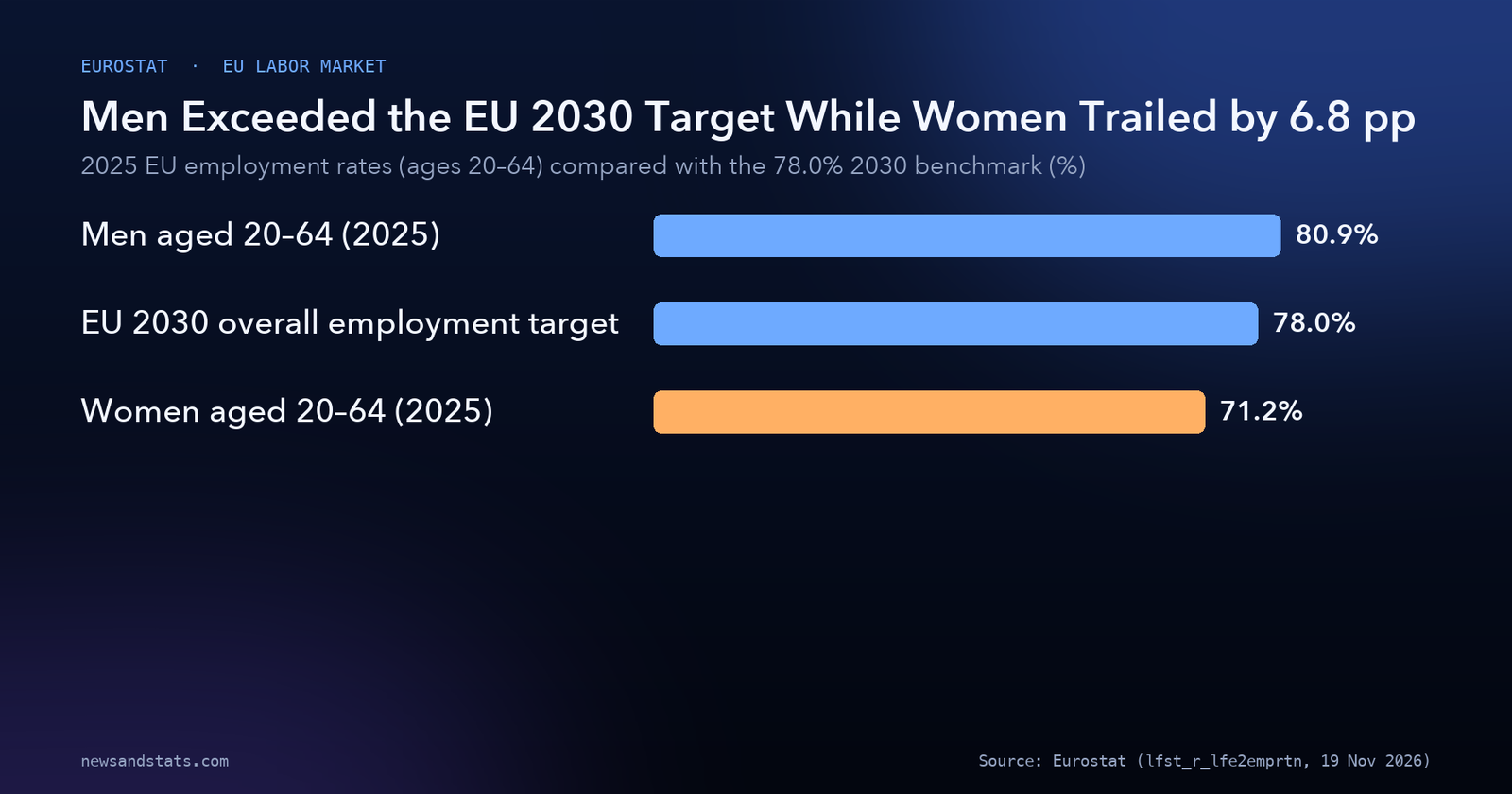
In 2025, 80.9% of men aged 20 to 64 in the European Union held a job, compared with 71.2% of women in the same age bracket. That 9.7-percentage-point difference—published by Eurostat on November 19, 2026 from its regional labor force dataset (lfst_r_lfe2emprtn)—represents a 0.3-percentage-point improvement from the 10.0-percentage-point gap recorded in 2024.
Beneath that modest bloc-wide narrowing in World in Numbers, Europe’s labor market is split across stark regional lines. Out of 244 statistical regions (NUTS 2) across the European Union, 65 regions have already hit the bloc’s 2030 target of 5.7 percentage points or less, whereas 26 regions—concentrated heavily in Greece, Italy, and Romania—still record gender employment gaps of 18.0 percentage points or more.
The 2025 headline numbers vs. the 2030 math
The European Pillar of Social Rights Action Plan pairs an overall 2030 employment rate goal of 78% with a commitment to halve the gender employment gap to 5.7 percentage points by 2030. Achieving that goal from the 2019 baseline required an average annual reduction of 0.5 percentage points per year.
| EU Labor Market Indicator (Ages 20–64) | Value | Benchmark or Context |
|---|---|---|
| Male employment rate (2025) | 80.9% | 2.9 pp above the 78% overall 2030 target |
| Female employment rate (2025) | 71.2% | 6.8 pp below the 78% overall 2030 target |
| EU gender employment gap (2025) | 9.7 pp | Down 0.3 pp from 10.0 pp in 2024 |
| EU 2030 gender employment gap target | 5.7 pp | Halving target under Pillar of Social Rights |
| Required annual pace (2025–2030) | 0.80 pp/year | 4.0 pp remaining reduction over 5 years |
| NUTS 2 regions already at 2030 target (<=5.7 pp) | 65 of 244 (26.6%) | Led by France (14), Germany (12), Sweden (7 of 8) |
| NUTS 2 regions in middle band (5.8–17.9 pp) | 153 of 244 (62.7%) | Majority of EU regional labor markets |
| NUTS 2 regions with high gap (>=18.0 pp) | 26 of 244 (10.7%) | Concentrated in Greece (10), Italy (8), Romania (5) |
Source: Eurostat, Regional gender employment gap (lfst_r_lfe2emprtn), November 19, 2026, and author calculations.
The arithmetic for the next five years is demanding. Moving from 9.7 percentage points in 2025 to 5.7 percentage points in 2030 requires eliminating 4.0 percentage points in five years—an average annual drop of 0.80 percentage points per year. That required pace is 2.67 times faster than the 0.30-percentage-point gain achieved between 2024 and 2025, and 60% faster than the 0.50-percentage-point annual trajectory originally modeled from 2019 onward.
Source: Eurostat (lfst_r_lfe2emprtn), November 19, 2026.
The 65 regions already at target: France, Germany, and Sweden lead
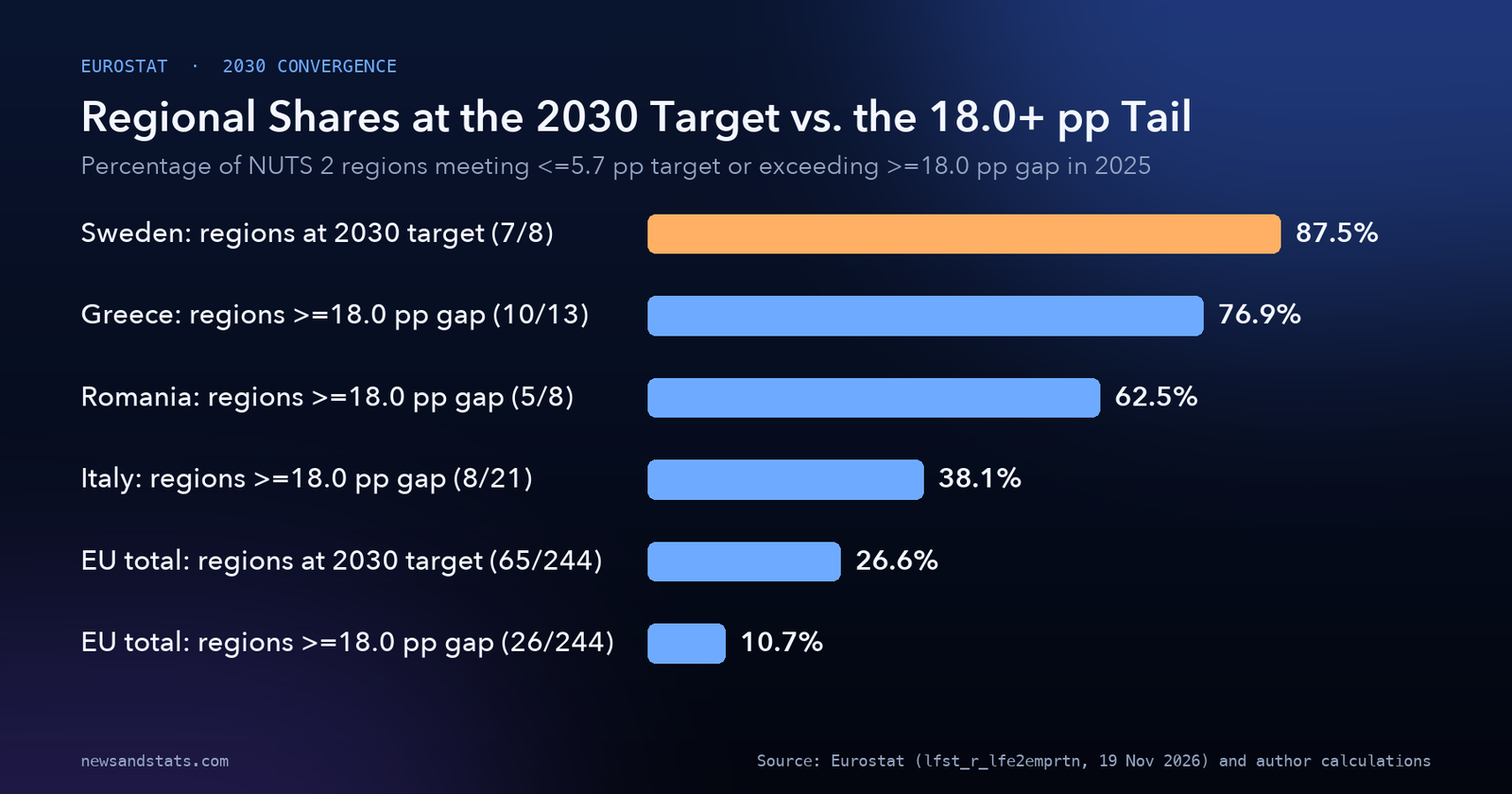
More than a quarter of the European Union’s regional economies—65 out of 244 NUTS 2 regions, or 26.6%—had already met or beaten the 5.7-percentage-point 2030 benchmark in 2025. Those early achievers are heavily clustered in Northern and Western Europe.
Three countries alone account for 33 of the 65 compliant regions, or 50.8% of the entire group. France leads with 14 regions at or below the 5.7-point threshold, followed by Germany with 12 regions. Sweden posts the highest national consistency reported in the release, with 7 out of its 8 NUTS 2 regions—87.5% of the country—already meeting the 2030 target five years ahead of schedule.
The 26 high-gap regions: Greece, Italy, and Romania carry the tail
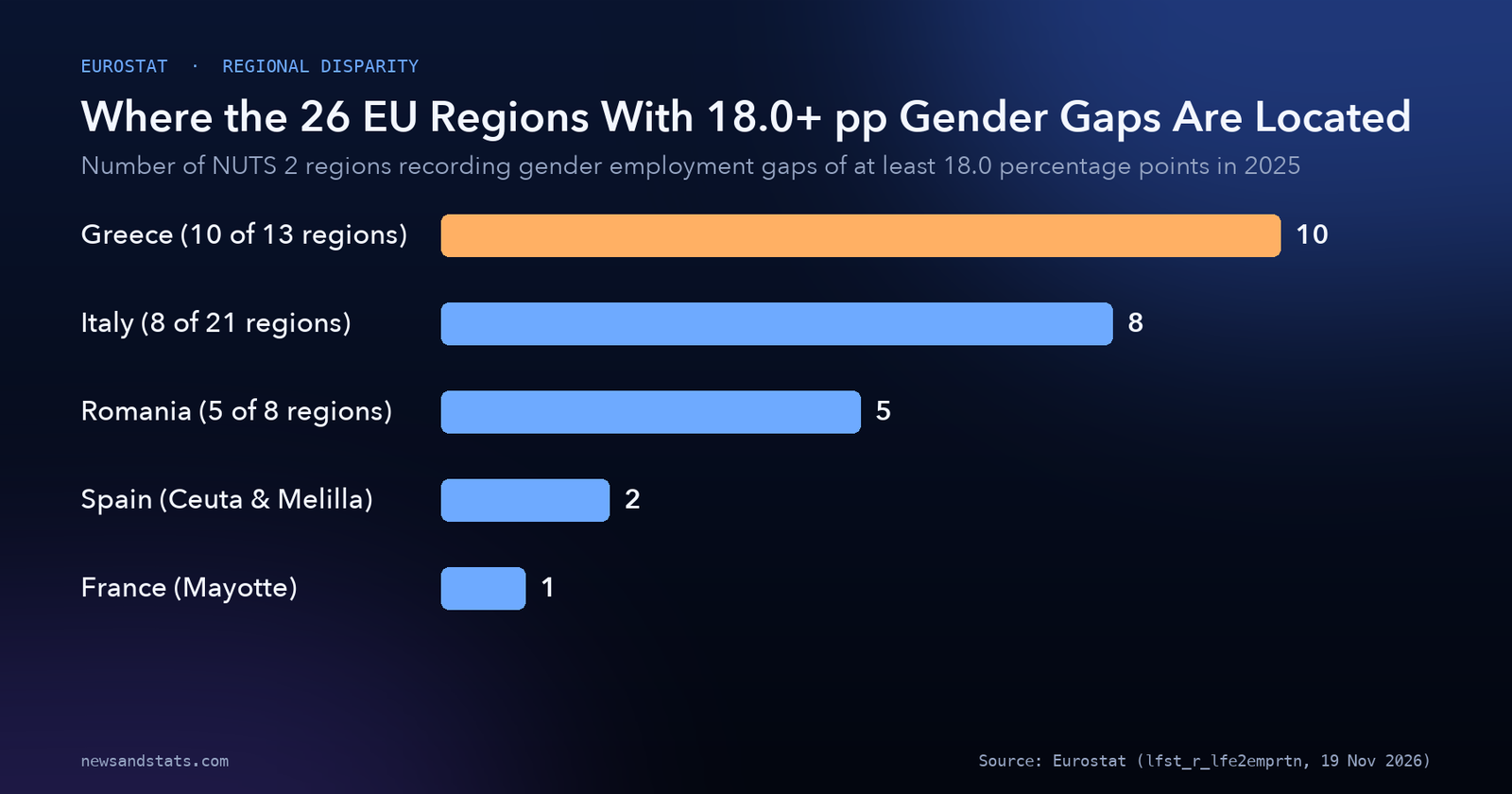
At the opposite end of the distribution, 26 NUTS 2 regions—10.7% of all 244 regions in the European Union—recorded gender employment gaps of at least 18.0 percentage points in 2025, more than triple the 2030 target of 5.7 points. Southern and Eastern European member states account for 23 of those 26 regions, alongside three autonomous or outermost territories.
Greece has the widest national concentration of high-gap regions: 10 of its 13 NUTS 2 regions (76.9%) posted gaps of 18.0 percentage points or more in 2025, with only Attiki (the Athens capital region), Ipeiros, and Kriti sitting below that threshold. Romania follows in share, with 5 of its 8 regions (62.5%) at or above 18.0 points, leaving only Bucureşti-Ilfov, Nord-Vest, and Vest below the cutoff.
Source: Eurostat (lfst_r_lfe2emprtn), November 19, 2026.
Italy accounts for 8 of the 26 high-gap regions, representing 38.1% of its 21 NUTS 2 regions. The remaining three regions in the 18.0-plus tier are Spain’s two North African autonomous cities, Ciudad de Ceuta and Ciudad de Melilla, and France’s Indian Ocean outermost region of Mayotte—illustrating how even a national leader like France (with 14 regions at target) faces localized labor-market outliers.
The missing middle: 153 regions between 5.8 and 17.9 percentage points
Subtracting the 65 regions already at or below 5.7 percentage points and the 26 regions at or above 18.0 percentage points leaves 153 NUTS 2 regions—62.7% of the European Union’s regional map—sitting in the middle band. Whether the bloc hits its 2030 headline goal of 5.7 points depends largely on how quickly these 153 mid-tier regions close gaps in the 5.8-to-17.9-point range.
Source: Eurostat (lfst_r_lfe2emprtn), November 19, 2026.
Because men’s 2025 employment rate (80.9%) already exceeds the EU’s 78% overall 2030 employment target by 2.9 percentage points, virtually all remaining progress toward both the 78% overall target and the 5.7-point gender gap target hinges on raising women’s employment from 71.2% toward 75.2% or higher over the next five years.
The 153 middle-band regions matter more for the bloc-wide average than either extreme, simply because of their sheer number: at 62.7% of all 244 NUTS 2 regions, they outnumber the 65 target-compliant regions and the 26 high-gap regions combined. A modest average improvement spread across 153 regions would move the EU-wide 9.7-point figure far more than an equivalent improvement concentrated only in the 26 regions already identified as laggards, which is one reason the required 0.80-percentage-point annual pace applies to the whole bloc rather than to any single country.
Economic stakes: labor supply, AI readiness, and fiscal resilience
Closing a 9.7-percentage-point regional employment gap is not solely a social equity metric; it is a macroeconomic growth lever. As European economies absorb higher energy costs from the 2026 energy shock and navigate shifting supply chains tracked in our global trade outlook, activating underutilized female labor capacity in Southern and Eastern Europe expands tax bases and eases pension and healthcare pressures.
At the same time, labor-force participation interacts directly with technological change. In our coverage of the OECD AI adoption gap, regions with stronger workforce participation and digital upskilling absorb AI-driven productivity gains faster, whereas regions with persistent employment gaps risk falling further behind—a dynamic equally visible in fiscal strain across low-income countries facing debt distress globally.
The national pattern behind both extremes points the same direction even where it is not absolute. France, Germany, and Sweden together supply 33 of the 65 target-compliant regions, or 50.8% of that group, even though France also has one region—its outermost territory of Mayotte—in the 26-region high-gap tail, a reminder that strong national averages can still mask isolated outlying regions. Greece, Italy, and Romania show the opposite concentration at national scale: 10 of Greece’s 13 regions, 8 of Italy’s 21 regions, and 5 of Romania’s 8 regions sit at or above the 18.0-point threshold. That broad split suggests the gap is driven as much by durable national labor-market structures—childcare availability, part-time work norms, and service-sector depth—as by isolated regional outliers alone.
What to watch
- Acceleration beyond 0.3 pp per year: Whether the EU-wide gender employment gap drops faster than 2025’s 0.3-percentage-point pace in 2026–2027 toward the 0.80 pp annual rate required to reach 5.7 pp by 2030.
- Southern and Eastern regional convergence: Whether non-capital regions in Greece (10 of 13 above 18.0 pp), Romania (5 of 8), and Italy (8 of 21) narrow gaps in female labor participation through childcare and service-sector expansion.
- Middle-tier conversion: How many of the 153 regions sitting between 5.8 pp and 17.9 pp cross below the 5.7-point threshold in the next Eurostat regional yearbook.
- Capital-to-region spillovers: Whether strong performance in Attiki, Bucureşti-Ilfov, Nord-Vest, and Vest spreads into neighboring Greek and Romanian regions.
The bottom line
Eurostat’s November 19, 2026 regional labor data shows a European Union moving in the right direction—from a 10.0-percentage-point gender employment gap in 2024 to 9.7 points in 2025—but at less than half the annual speed needed to hit its 5.7-point target by 2030. With 65 of 244 regions already across the finish line and 26 regions still stuck at 18.0 points or higher, closing Europe’s remaining 4.0-point gap depends on unlocking female employment in Southern and Eastern Europe rather than pushing already-converged Northern and Western hubs.