

Data breaches cost more in 2026 than in any year on record: a global average of $4.99 million, a 12% jump from 2025. The reason is no longer just phishing emails and stolen passwords. IBM’s Cost of a Data Breach Report 2026, based on breaches at 602 organizations worldwide, found that artificial intelligence is reshaping both sides of the ledger — attackers are using AI to scale deepfake scams and malware, while employees’ unauthorized use of AI tools is quietly driving up costs inside the companies that get breached. Shadow AI data breach costs are no longer a hypothetical risk: shadow AI now touches more than four in ten security incidents, and most breached organizations still have no framework to govern it. The report draws on breaches organizations actually experienced between March 2025 and February 2026, which makes it the most current year-over-year comparison available for how AI is changing the economics of cybersecurity.
A record $4.99 million, and AI is driving it
The global average cost of a data breach reached $4.99 million in IBM’s Cost of a Data Breach Report 2026, the highest figure the report has ever recorded. IBM attributes the record to higher detection, escalation and lost-business costs. Those three categories alone made up roughly 63% of the total bill in a typical breach this year. Layered on top of that baseline is a new variable: breaches that involved artificial intelligence, either as the attacker’s tool or as the target.
| Measure | 2026 value | Change vs. 2025 |
|---|---|---|
| Global average cost of a data breach | $4.99 million | +12%, a record high |
| Average cost of an AI-enabled malicious breach | $6.0 million | AI-driven attacks up 56% |
Source: IBM’s Cost of a Data Breach Report 2026 (linked above), and IBM’s July 2026 announcement of the AI-enabled breach findings.
One in four malicious breaches are now AI-enabled
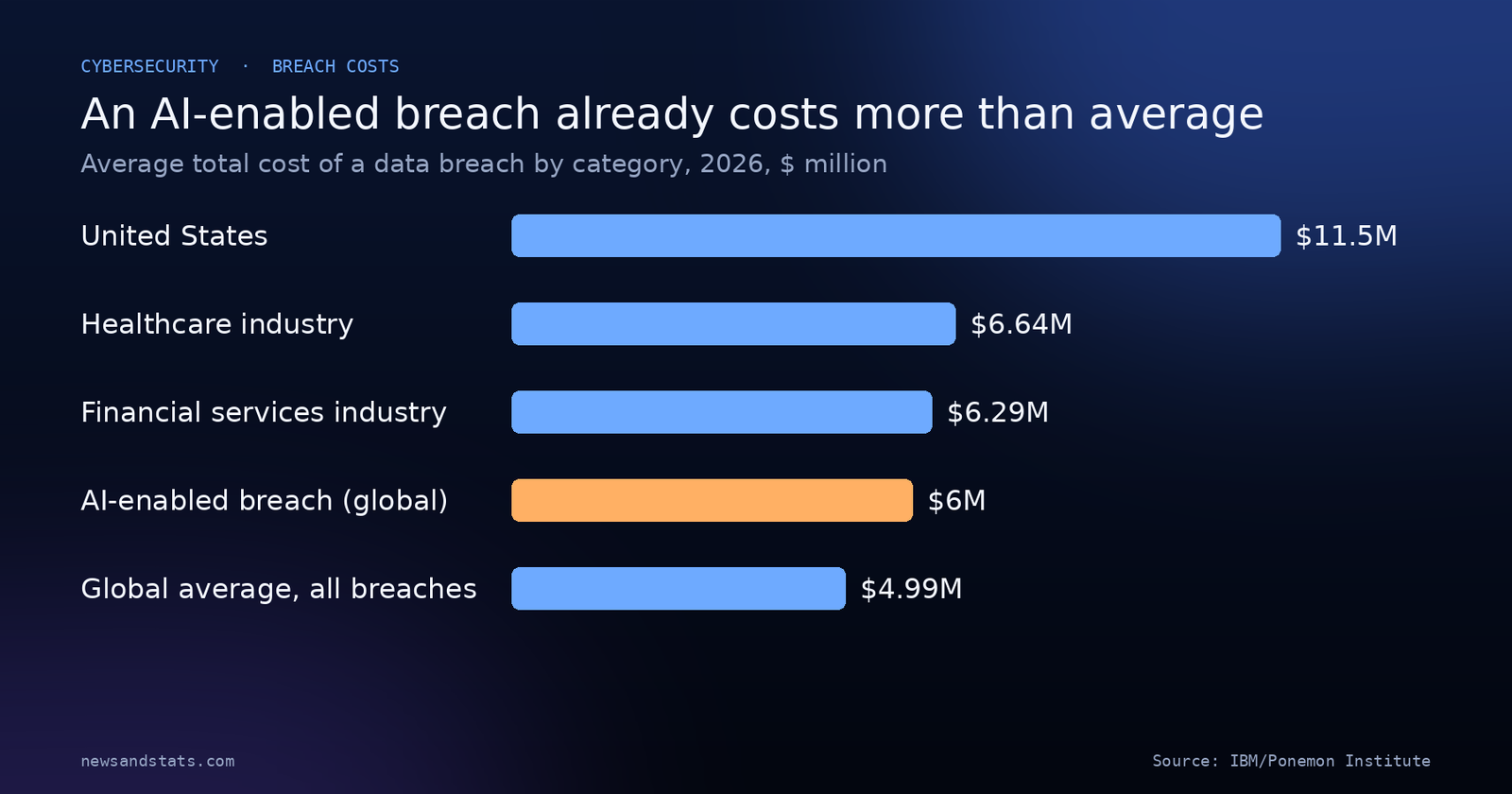
Among malicious breaches in IBM’s sample, one in four — 25% — involved an AI-enabled attack technique, up 56% from the year before. Deepfake impersonation and AI-generated malware led the increase. Those AI-enabled breaches cost an average of $6.0 million, about $1 million more than the overall global average, and 62% of them targeted critical-infrastructure sectors. Within that group, financial-services breaches averaged $6.3 million and energy breaches averaged $5.2 million, two of the costliest sector-level figures in the AI-attack data.
AI is not only a weapon; it is increasingly a target in its own right. More than 20% of organizations reported a breach that targeted an AI model or application directly, most often through compromised APIs, applications or plug-ins (27%) or cloud misconfigurations that exposed AI workloads (27%). The surge comes as companies deploy AI at a pace that the Stanford AI Index 2026 tracked as a record year for private AI investment, often faster than security teams can keep up.
The shadow AI data breach costs hiding in plain sight
Shadow AI — generative tools employees adopt without their security team’s knowledge or approval — is no longer a side issue. The share of security incidents involving shadow AI more than doubled year over year to 43% in 2026, Cybersecurity Dive’s reporting on the study found. The underlying cause looks organizational more than technical: more than two-thirds of breached organizations, 68%, had no governance framework in place to limit shadow AI, a separate analysis of the same data by Forkast found.
That gap shows up across several related practices, all measured among the organizations that IBM’s researchers studied after a breach.

Source: Cybersecurity Dive and Forkast, based on IBM Security’s X-Force analysis of the report.
Even organizations that use AI defensively often leave their own AI systems unprotected. IBM Security’s X-Force team found that only 40% of organizations apply access controls to their own AI models and data, and among organizations that suffered an AI-related breach, 92% lacked proper AI access controls altogether. The pattern echoes the uneven rollout documented in the OECD AI Divide: AI tools are spreading through organizations faster than the policies meant to govern them.
Within the subset of incidents that targeted AI systems directly, the type of attack mattered for cost too. Model-inversion attacks, where an adversary tries to extract the training data behind a model, averaged $6.07 million per incident, slightly above the overall AI-enabled breach average. Prompt-injection attacks, which manipulate an AI system’s own instructions to make it behave in unintended ways, averaged $5.89 million. Both figures come from IBM Security’s own analysis of the report, a reminder that attacking the AI itself is now about as expensive to clean up as attacking around it.
The defenders fight back with AI too
AI is not only raising costs. Used deliberately, it also lowers them. Organizations that reported extensive use of AI and automation in their security operations cut their average breach cost by nearly $1.93 million compared with organizations using none at all, according to IBM Security’s X-Force team. More than half of breached organizations now use AI agents for threat detection and containment, though only 18% have extended that to vulnerability management, the weaker link in the chain.
The lesson appears to be landing, at least on paper. In a Ponemon Institute follow-on survey conducted in May 2026, 85% of organizations said that simply learning about frontier AI capabilities was pushing them to increase security spending, more than the 64% who said the same after actually experiencing a breach. Whether that spending closes the governance gap or just adds more tools to a pile employees do not fully trust is an open question — one our look at the developer AI trust gap explored from a different angle.
Healthcare and the United States pay the most
Industry and geography still matter more than almost anything else in these figures. Healthcare remained the costliest industry to get breached for the 13th consecutive year, averaging $6.64 million per incident in 2026, though that is actually down 10.5% from $7.42 million in 2025. Financial services ranked second at $6.29 million.
Source: eSecurity Planet, SureCloud and Becker’s Hospital Review, reporting on IBM’s Cost of a Data Breach Report 2026.
Geography widens the gap further. Breaches at organizations in the United States averaged $11.5 million in 2026, more than double the global figure, making it by far the most expensive place in the world to clean up after an attack. Higher regulatory fines, higher incident-response wages and a larger share of highly regulated, high-value data all plausibly contribute, though the underlying research does not break out exactly how much each factor adds. Smaller companies are affected unevenly too: thinner security budgets leave less room to absorb a breach like this, a gap that runs through AI adoption by firm size more generally, not just security spending.
Slow breaches cost far more
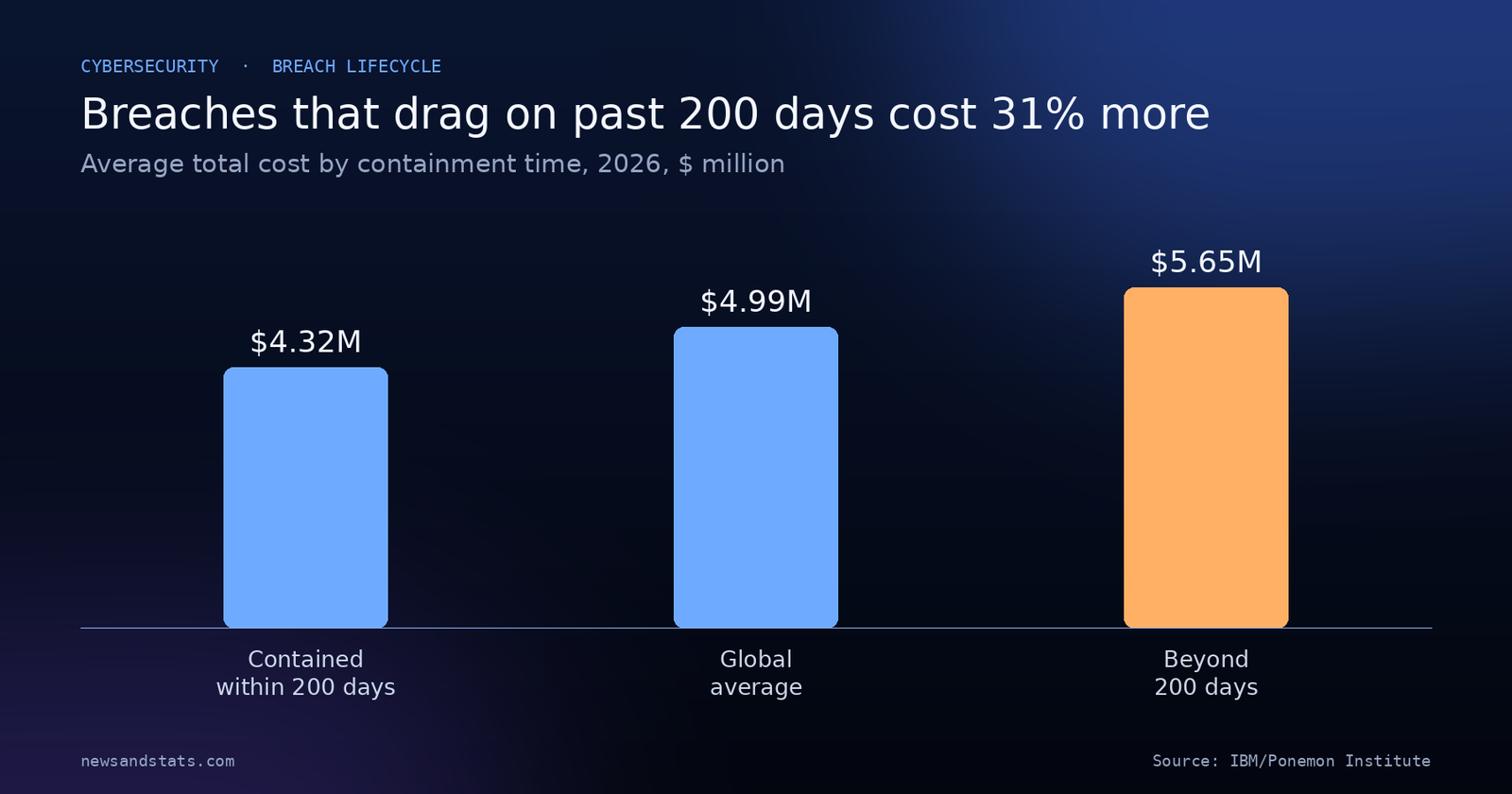
How long a breach goes undetected matters as much as what caused it. The mean time to identify and contain a breach rose to 247 days in 2026, reversing several years of steady improvement. Breaches contained within 200 days cost an average of $4.32 million, while those that dragged on past 200 days cost $5.65 million, about 31% more, by my calculation.
Source: a Baker Donelson summary of the report’s findings and Help Net Security’s coverage of the breach-lifecycle data.
The pattern reinforces something IBM’s research has tracked for years: speed is one of the few variables fully within a security team’s control, regardless of whether the attacker used AI or not.
Ransomware, extortion and the encryption gap
Ransomware kept climbing too. Some 39% of breached organizations reported a ransomware incident in 2026, up from 34% the year before, and attackers increasingly use AI to automate and scale these operations. When attackers pressured victims to pay, the most common lever was the threat of damaging brand reputation (41%), followed by exfiltrating employee data (35%) and stealing intellectual property (31%).
Basic hygiene remains a weak point industry-wide. Only 37% of breached organizations said they encrypt sensitive data both at rest and in transit, and just 34% have visibility into their own cryptographic assets, gaps that predate AI entirely but that AI-enabled attackers are now better equipped to exploit. None of these particular failure modes are new problems invented by AI; ransomware, extortion and weak encryption have sat near the top of breach reports for years. What has changed is the speed and scale at which AI lets attackers automate the reconnaissance, phishing and malware-writing steps that used to take a human crew days to carry out by hand, from unencrypted data to the rapid, lightly reviewed spread of AI coding agents through production systems.
What it means for AI at work
None of this is happening in a vacuum. Companies are pouring money into AI at a pace our coverage of the hyperscaler capex 2026 AI infrastructure boom has tracked in detail, and AI is already reshaping hiring and day-to-day tasks, as we found in our look at the AI employment shift underway at major employers. The 2026 breach numbers add a new line item to that transformation: AI is now also a line item on the cybersecurity budget, whether companies plan for it or not. Security teams are effectively being asked to govern a technology that makes their own jobs faster and their adversaries’ jobs faster at the same time, and the 2026 data suggests most of them have not yet written the rules for how employees are allowed to use it. For more on how artificial intelligence is reshaping daily work, see our full AI & Work coverage.
What to watch
- Whether IBM’s 2027 edition, due next summer, shows the AI-enabled breach premium widening or narrowing as governance catches up.
- Whether the share of organizations applying access controls to their own AI systems moves past the 40% reported in 2026.
- Whether the gap between the global average ($4.99 million) and the US average ($11.5 million) narrows as AI-driven incidents spread to other regions.
- Whether healthcare’s 13-year run as the costliest breached industry finally breaks, now that its 2026 average has fallen for a second straight year.
- Whether AI-agent use in vulnerability management grows beyond the current 18%, closing the gap with the more than 50% already using agents for threat detection.
- Whether the 85% of organizations that said they would raise security spending after learning about frontier AI capabilities actually follow through in next year’s survey.
The bottom line
The 2026 numbers tell two stories inside the same $4.99 million average: AI is making some attacks faster and costlier, while also helping some defenders cut costs by nearly $2 million when they use it well. The gap between those outcomes comes down to governance, not technology — 68% of breached organizations had no framework for the shadow AI already running inside their business. Healthcare and the United States remain the most expensive places to get breached, and breaches that take more than 200 days to contain cost about 31% more than those closed sooner, by my calculation. None of this means AI is making security worse on net; it means the organizations pairing AI defenses with real oversight of AI use are starting to pull ahead of everyone else.
Related reading
- The OECD AI Divide: why AI governance and adoption gaps vary so much between organizations and countries.
- Stanford AI Index 2026: the scale of AI investment now drawing attackers as well as defenders.
- AI Employment Shift: how AI agents are already reshaping day-to-day work, for better and worse.
- The $750 billion AI bet: the infrastructure boom behind both the opportunity and the new attack surface.


