Startups worldwide raised $170.9 billion in venture capital in the third quarter of 2026, according to KPMG’s quarterly Venture Pulse report — a second straight quarterly decline after a record-shattering start to the year. Global venture capital 2026 has swung from a $330.9 billion peak in the first quarter, fueled by a handful of giant artificial-intelligence rounds, down to a market that looks calmer on the surface but is, if anything, more concentrated underneath. In the United States, AI companies took 20 of the 23 funding rounds worth $1 billion or more in Q3 alone. The headline total is shrinking. The share of it flowing to one sector is not.
1. Global venture capital 2026: $170.9 billion, and a second quarter of decline
KPMG’s Venture Pulse Q3’26 report put global venture capital investment at $170.9 billion across 8,341 deals in the third quarter of 2026. That is down from $227.4 billion in the second quarter and far below the first quarter’s $330.9 billion. By my calculation, the fall from the Q1 record to Q3 works out to a 48.4% decline in dollar terms (see Calculations). KPMG frames it differently than a simple slump, though: the report says activity “remained well above historical norms” even after the drop, and attributes the decline mainly to the “absence of the outlier deals seen earlier in the year” rather than to a broader pullback. The Stanford AI Index found AI private investment surging across all of 2025 on a different, broader measure of capital; KPMG’s narrower, venture-only, quarter-by-quarter data is what shows just how lumpy that capital has become within a single year.
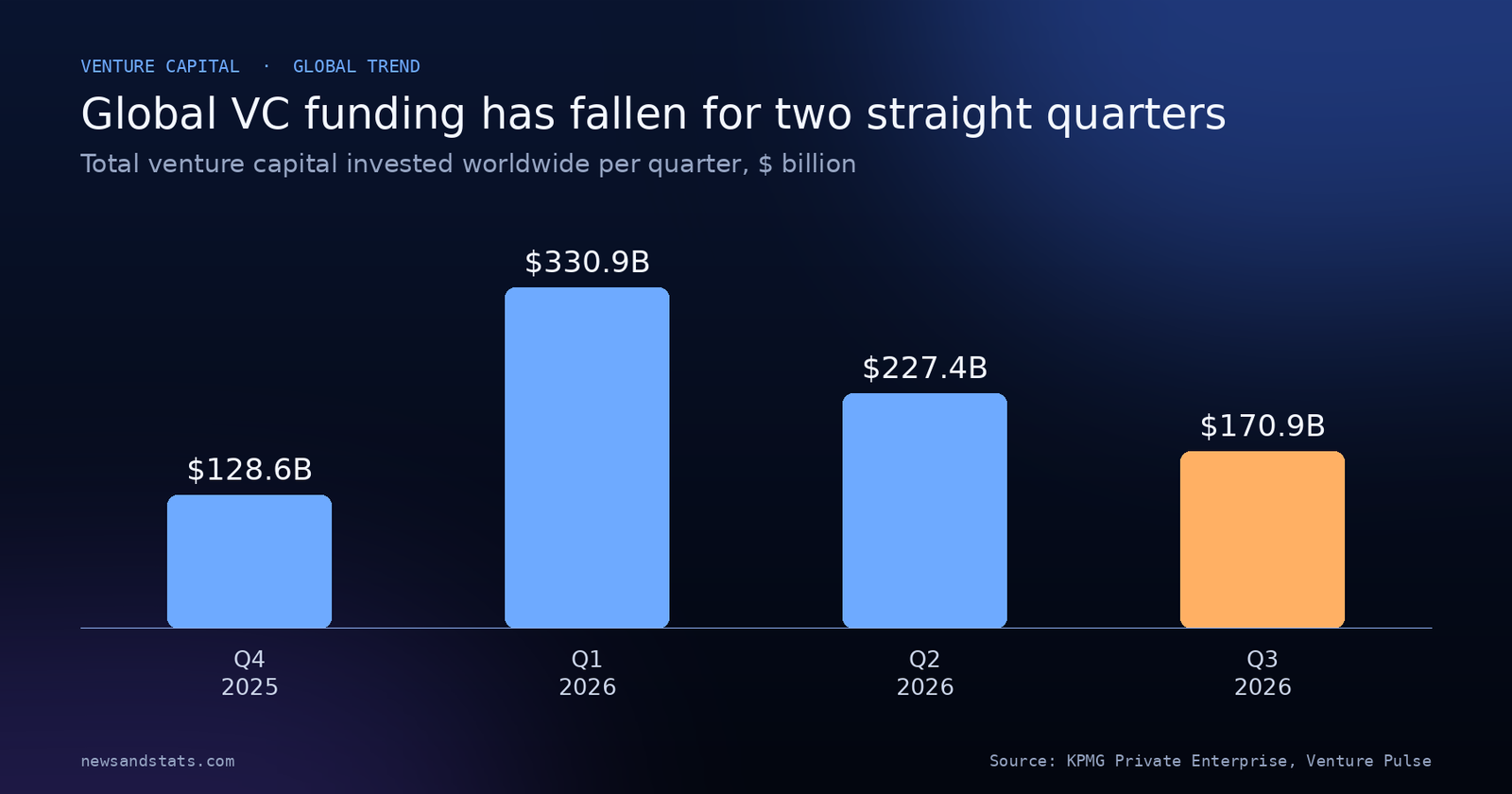
Source: KPMG, Venture Pulse Q3’26; KPMG, Q1’26 press release; KPMG, H1’26 press release.
The deal count tells a quieter but steadier story. Global deal volume has fallen every quarter since the end of 2025: from 10,097 deals in the fourth quarter of 2025, to 8,464 in the first quarter of 2026, to 8,440 in the second, to 8,341 in the third. That is a 17.4% drop in deal count from Q4 2025 to Q3 2026 (my calculation), even as dollar totals swung far more wildly. Fewer deals, in other words, are splitting a pool of capital that briefly got much larger and has since partly receded — a pattern consistent with money concentrating in fewer, bigger checks rather than spreading across more companies.
2. How one quarter got to $330.9 billion
The first quarter of 2026 was not a broad boom; it was a handful of extraordinary rounds. KPMG’s April release on the quarter says global VC investment “more than doubled from $128.6 billion in Q4’25 to a record $330.9 billion in Q1’26,” and that ten funding rounds of $2 billion or more contributed over $206 billion of that total on their own — meaning roughly 62% of the entire quarter’s global capital sat in just ten deals. The release names the two largest explicitly: OpenAI raised $122 billion and Anthropic raised $30.6 billion in the quarter, with xAI’s $20 billion round close behind. Those three AI labs alone account for roughly $172.6 billion, or about 52% of everything invested worldwide that quarter (my calculation). This is the same dynamic behind what hyperscalers are spending on AI infrastructure: the money raised by AI labs and the money hyperscalers pour into data centers are different pools of capital, but both point the same direction.
3. The Americas drew more than Asia and Europe combined
Regionally, Q3 2026 looked lopsided. KPMG’s Q3 report puts the Americas at $101.2 billion across 3,947 deals, Asia at $39.8 billion, and Europe at $28.4 billion across 1,497 deals. The Americas total alone — $101.2 billion — was larger than Asia and Europe added together ($68.2 billion), a gap of roughly 59.2% of the global total sitting in one region (my calculation).
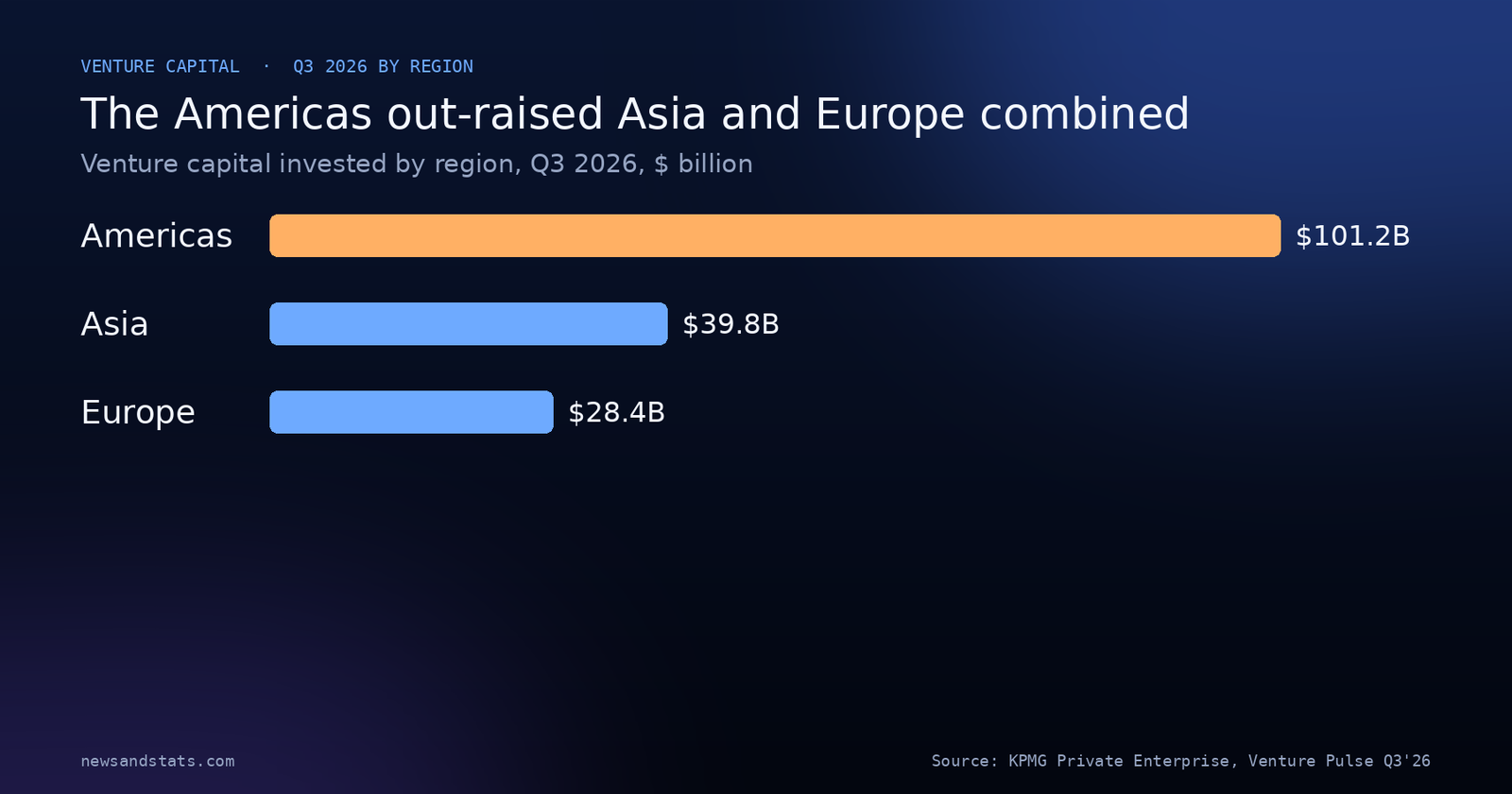
Source: KPMG, Venture Pulse Q3’26.
Within the Americas, the United States did almost all of the work: $98.4 billion across 3,626 deals, or 97.2% of the regional total (my calculation). That is itself a steep comedown from the US figure in the first quarter of 2026, when KPMG’s April release put US investment at $267.2 billion. The decline from $267.2 billion in Q1 to $98.4 billion in Q3 works out to 63.2% (my calculation) — a sharper fall than the global figure, because so much of Q1’s record was concentrated in US-based AI labs.
| Quarter | Global VC ($B) | Global deals | Americas ($B) | US ($B) | Europe ($B) | Asia ($B) |
|---|---|---|---|---|---|---|
| Q4 2025 | 128.6 | 10,097 | 78.6 | 72.6 | 23.4 | 26.2 |
| Q1 2026 | 330.9 | 8,464 | 270.1 | 267.2 | 25.7 | 31.8 |
| Q2 2026 | 227.4 | 8,440 | 150.0 | 144.9 | 25.6 | 50.8 |
| Q3 2026 | 170.9 | 8,341 | 101.2 | 98.4 | 28.4 | 39.8 |
Source: KPMG, Venture Pulse Q3’26; KPMG, Q1’26 press release; KPMG, H1’26 press release.
4. AI took 20 of the 23 US billion-dollar rounds
The clearest sign of concentration sits inside the US mega-deal count. KPMG’s Q3 report records “a record 23 funding rounds valued at $1 billion or more” in the United States during the quarter, and says AI accounted for 20 of them. That is 87.0% of every US billion-dollar-plus round in the quarter going to a single sector (my calculation). Those 20 AI rounds alone, KPMG says, contributed $37.8 billion of the US total of $98.4 billion. The named deals include Databricks ($5 billion), Crusoe ($3.9 billion), Cognition ($2 billion), Thrive Holdings ($2 billion), Hadrian ($1.7 billion) and Atoms ($1.7 billion). This is the flip side of the global AI talent race: the capital follows the same narrow set of AI labs and infrastructure companies that are also absorbing the lion’s share of research talent.
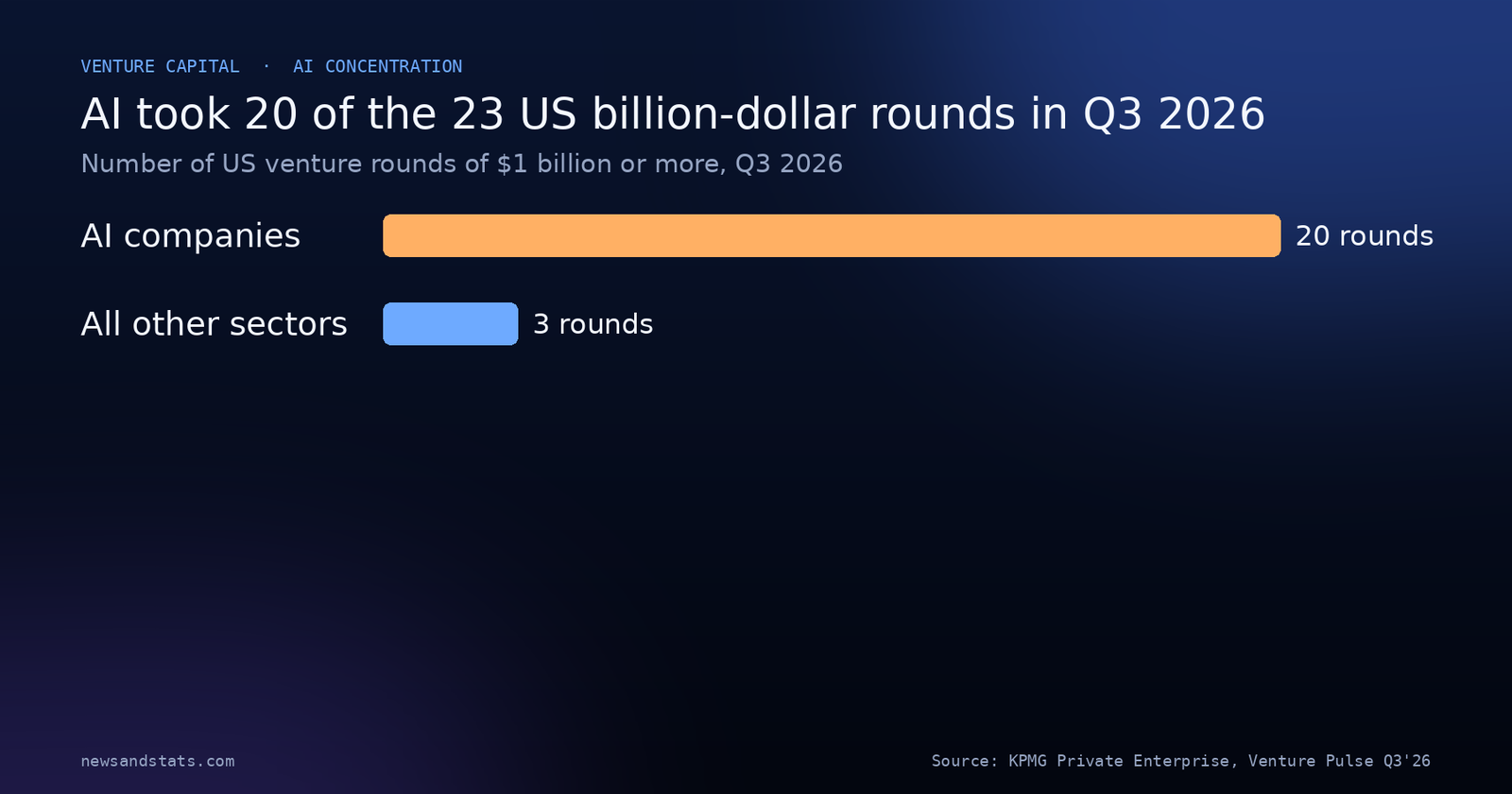
Source: KPMG, Venture Pulse Q3’26.
5. The rest of the US market, bifurcated
KPMG’s own language for this is blunt: the US venture market in Q3 2026 “remained highly bifurcated.” On one side sit the AI megadeals described above. On the other, KPMG notes that total funds raised by US venture firms in 2026 reached $108.5 billion by the end of Q3 — already above all of 2025 — while first-time fundraising, the money new and emerging venture firms manage to raise, sat at “a more than 10-year low.” In plain terms: existing, large funds are raising more capital than ever, while new entrants to the venture business are finding it harder to raise their first fund than at any point in over a decade. That split echoes McKinsey’s enterprise ROI gap found elsewhere in the AI economy this year: big, established players pulling ahead while newer or smaller players struggle to keep pace.
6. Europe’s uneven quarter
Europe’s $28.4 billion in Q3 2026 was, according to KPMG, “a 16-quarter high” for the region — notable because it came even as the global total fell. But the regional total masks a split: Germany raised $5.3 billion, its fourth straight quarter of increasing investment, while the UK softened to $6.8 billion. Europe recorded six deals of $1 billion or more in the quarter: Mistral AI ($3.5 billion), Helsing ($1.8 billion), Quantum Systems ($1.2 billion), Wayve ($1.2 billion), Domyn ($1.1 billion) and Cyera ($1 billion). Four of those six — Mistral AI, Helsing, Quantum Systems and Wayve — are AI, defense-AI or autonomy companies, which lines up with the same concentration pattern seen in the United States, built on the same underlying demand for the global chip sales blowing past forecasts that power these models, and for the memory chips squeezed by the DRAM shortage elsewhere in the same supply chain.
7. The smaller markets bucking the trend
Not every market shrank. KPMG’s Q3 report singles out Mexico, where VC investment rose from $441 million in Q2 2026 to $693 million in Q3, and Brazil, where it rose from $390 million to $609 million over the same period — both growing even as the US and the global totals fell. Canada moved the other way: $866.3 million across 155 deals, which KPMG describes as the country’s lowest quarterly investment total since the third quarter of 2018, an eight-year low. The pattern is not a uniform global slowdown; it is a reshuffling, with capital pulling back hardest from markets most exposed to last year’s largest AI outlier rounds and holding up or growing in markets that were never as exposed to them.
8. Asia’s smaller, but AI-adjacent, pullback
Asia’s $39.8 billion in Q3 2026 continues a downward move from the region’s $50.8 billion in Q2 2026, a quarter KPMG’s mid-year materials described as Asia’s strongest since the fourth quarter of 2021. The quarter-over-quarter change works out to a 21.7% decline (my calculation). Asia’s Q3 total was still above both Q4 2025’s $26.2 billion and Q1 2026’s $31.8 billion, meaning the region’s 2026 trend has run in the opposite direction from the Americas: rising through the first half of the year, then cooling only in the third quarter, rather than spiking and crashing around a single record quarter.
9. Why the deal count keeps falling even as some totals rise
Across every region, one figure has moved in a single direction all year: the number of deals. Global deal counts fell in every one of the last four quarters tracked here — never once ticking back up — while dollar totals bounced around a large, outlier-driven peak. That combination (fewer deals, a brief dollar spike, then dollars falling back toward but not down to pre-spike levels) is consistent with capital increasingly routed through a smaller number of large, selective checks rather than spread across a broader base of new companies. It mirrors the pattern already visible in cloud market share, where a handful of providers capture a disproportionate share of a fast-growing market: venture capital, like the cloud infrastructure that increasingly underpins AI products, has it most concentrated at the very top.
10. How this gets misread
It is tempting to read “venture capital fell 48% from its record” as evidence the AI boom is fading. The data does not support that reading. What fell was the quarterly total, driven almost entirely by the absence of a repeat of Q1’s singular outlier rounds (OpenAI’s $122 billion, in particular, is not the kind of event that recurs every quarter). What did not fall, on KPMG’s own figures, is AI’s grip on the rounds that remain: 20 of 23 US billion-dollar-plus deals in Q3, a market KPMG itself calls “bifurcated,” and record fund totals at the largest, most AI-exposed venture firms even as first-time fundraising hits a decade low. A shrinking total and a more concentrated market are not contradictory; in this data, they are the same story told two ways. Readers should also note that “AI & Work” coverage of AI investment uses several different yardsticks across sources — annual private-investment indices, quarterly venture totals, and corporate capital spending are three different measures of three different kinds of money, and this article’s numbers describe only the second of those three.
What to watch
- KPMG’s Q4 2026 Venture Pulse report, typically published in January 2027, will show whether the decline continues, stabilizes, or reverses as the year closes.
- Whether another outlier-sized AI round appears. Q1 2026’s record depended on OpenAI, Anthropic and xAI each raising unusually large sums in the same three-month window; a similar cluster could again distort a future quarter’s total.
- First-time fund formation in the US, currently at a more than 10-year low; a continued decline would mean fewer new venture firms entering the market even as existing ones raise record sums.
- Whether Asia’s Q3 pullback continues or reverses, given the region’s 2026 trend has run opposite to the Americas so far.
- Smaller-market momentum in Mexico and Brazil, both of which grew quarter-over-quarter even as the US and global totals fell.
- The ratio of AI to non-AI megadeals in the US and Europe, as a simple, trackable proxy for how concentrated venture capital remains.
The bottom line
Global venture capital fell to $170.9 billion in the third quarter of 2026, down from a $330.9 billion first-quarter record built on a handful of giant AI rounds. But the decline is a story about outliers fading, not about AI funding drying up: AI companies still took 20 of the 23 US rounds worth $1 billion or more in the quarter, and total US fund sizes hit a record even as first-time fundraising hit a decade low. The venture market is smaller than it was in Q1. It is not less concentrated.
Related reading
- Stanford AI Index 2026 in 8 Numbers: the annual, broader-measure companion to this article’s quarterly venture-only data.
- The $750 billion AI bet: who spends it, and who pays: the corporate capital-spending side of the same AI buildout.
- The Global AI Talent Race in 8 Numbers: the people behind the AI labs this article’s megadeals fund.
- The State of AI 2026 in 8 Numbers: the enterprise-adoption gap that mirrors the funding market’s bifurcation.