
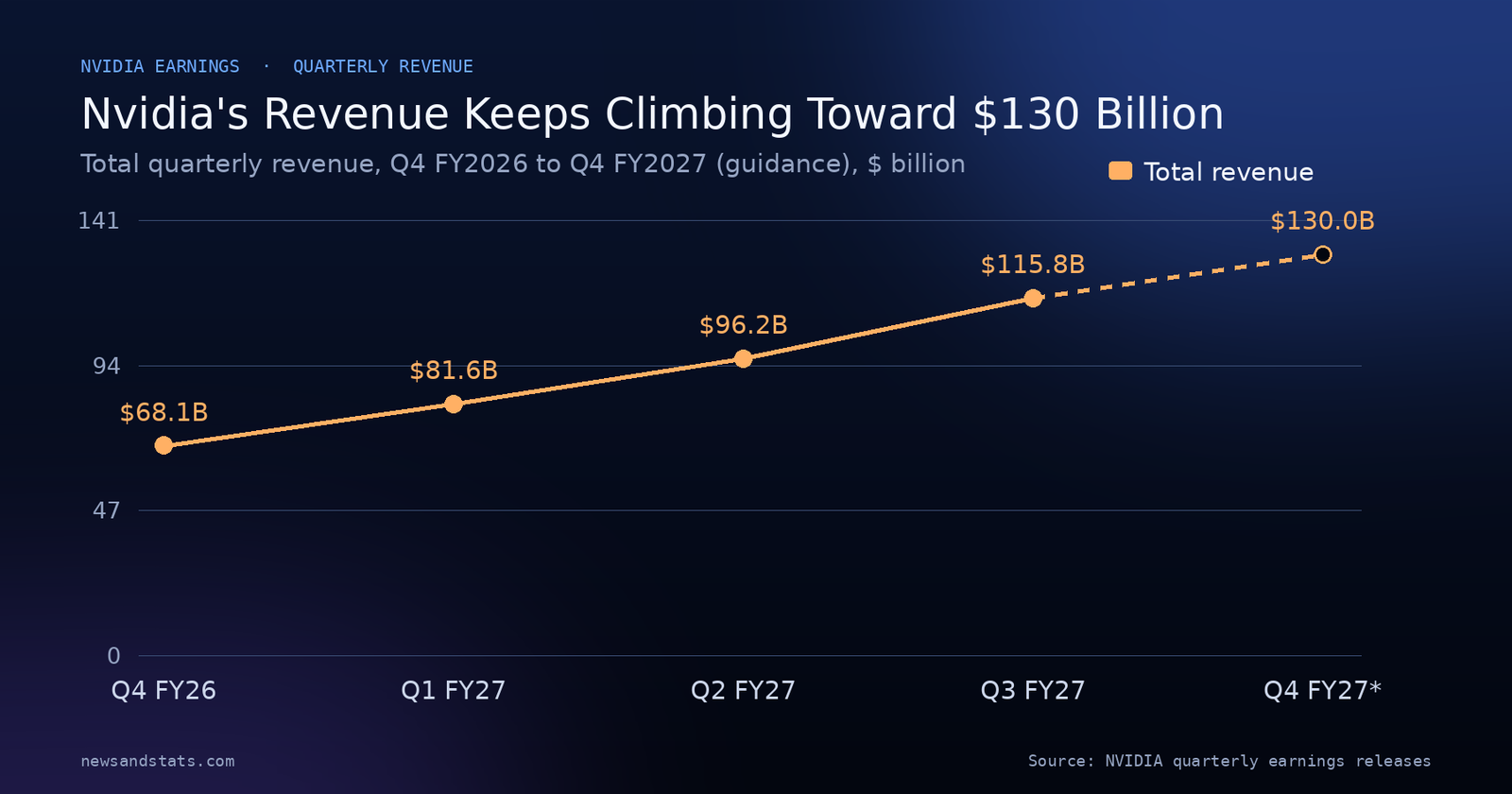
Nvidia closed its fiscal third quarter with $115.8 billion in revenue, up 103% from a year earlier, and told investors to expect roughly $130.0 billion more next quarter. Nvidia’s fiscal year runs about one quarter ahead of the calendar: fiscal 2027 began in late January 2026, so this third quarter covers the three calendar months from late July to late October 2026. The company reported those results on 17 November 2026, five days after announcing that Jensen Huang had resigned as president, chief executive and board member, with chief financial officer Colette Kress stepping in as interim CEO. Both events came from Nvidia’s own filings this month, and together they show a business still growing at an extraordinary pace while its leadership changes. Data center revenue, not gaming or any other product line, is now almost all of that growth.
1. $115.8 billion: a third straight revenue record
Nvidia’s third-quarter fiscal 2027 earnings release put total revenue at $115.8 billion for the quarter ended 25 October 2026, up 20% from the prior quarter and 103% from the $57.0 billion the company reported a year earlier. It is the fifth quarter in a row of sequential growth, following $68.1 billion in the quarter that closed fiscal 2026, then $81.6 billion, then $96.2 billion. Across the broader chip industry, chip sales have blown past every forecast set for the year, and Nvidia’s own trajectory has been the steepest part of that curve.
Source: NVIDIA Q3 FY2027 earnings release; Q2 FY2027 release; Q1 FY2027 release; Q4 FY2026 release.
2. Data Center revenue is now 93% of Nvidia’s business
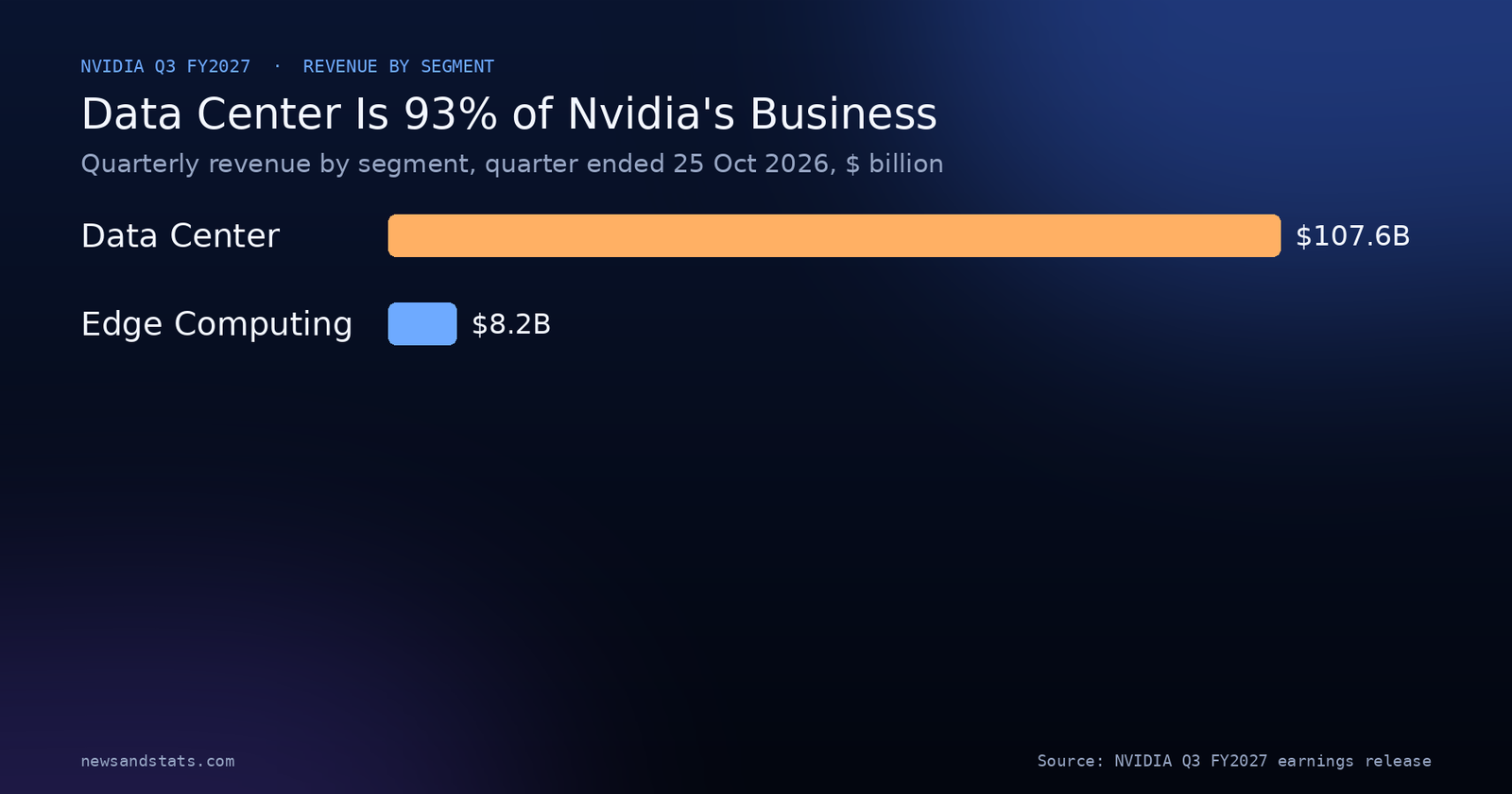
Of that $115.8 billion, $107.6 billion came from Nvidia’s Data Center segment, up 21% from the prior quarter and 110% from a year earlier. The remaining $8.2 billion came from what the company now calls Edge Computing, up 14% sequentially and 42% year on year. By my calculation, Data Center made up about 93% of total revenue in the quarter ($107.6 billion of $115.8 billion), a share that has risen steadily: it was roughly 91% a year ago and has climbed every quarter since. That concentration is part of why the hyperscaler capex bet by Nvidia’s largest customers matters so much to its own results — the two are now, by the numbers, nearly the same story.
3. The segment math
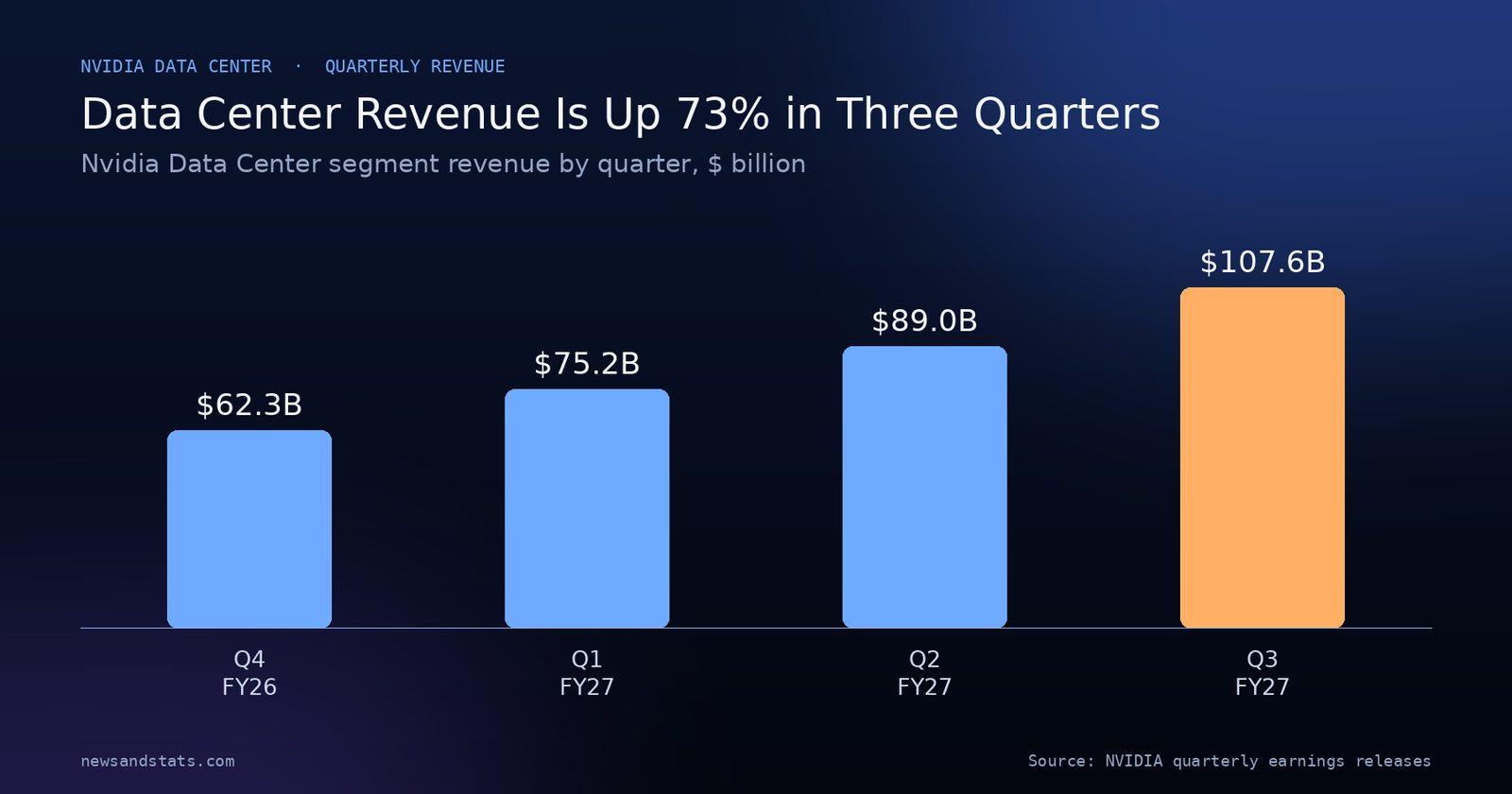
Nvidia’s own figures let the arithmetic be checked directly. Data Center revenue has grown from $62.3 billion in the quarter that closed fiscal 2026, to $75.2 billion, to $89.0 billion, to $107.6 billion today. By my calculation, that is growth of about 73% in three quarters ($107.6 billion versus $62.3 billion). The chip itself is only part of that figure: in the first quarter of fiscal 2027, Nvidia broke the segment into $60.4 billion of “Data Center compute” and $14.8 billion of networking gear, the latter up 199% from a year earlier — a reminder that the business increasingly sells whole systems, not just processors, the same shift behind the DRAM shortage that followed as memory-hungry AI servers strained supply elsewhere in the chain.
Source: NVIDIA Q3 FY2027 earnings release; Q2 FY2027 release; Q1 FY2027 release; Q4 FY2026 release.
| Quarter | Total revenue | Data Center revenue | GAAP gross margin | GAAP diluted EPS |
|---|---|---|---|---|
| Q4 FY2026 (ended 25 Jan 2026) | $68.1 billion | $62.3 billion | 75.0% | $1.76 |
| Q1 FY2027 (ended 26 Apr 2026) | $81.6 billion | $75.2 billion | 74.9% | $2.39 |
| Q2 FY2027 (ended 26 Jul 2026) | $96.2 billion | $89.0 billion | 75.0% | $2.46 |
| Q3 FY2027 (ended 25 Oct 2026) | $115.8 billion | $107.6 billion | 74.8% | $2.70 |
| Q4 FY2027 (guidance) | $130.0 billion (±3%) | not guided | 71.0%–72.0% (guided) | not guided |
Source: NVIDIA’s Q4 FY2026, Q1 FY2027, Q2 FY2027 and Q3 FY2027 earnings releases.
4. Margins held near 75%, then the company guided them lower
Gross margin — the share of revenue left after the direct cost of building each chip and system — stayed close to 75% all year: 75.0% in the quarter that closed fiscal 2026, 74.9% then 75.0% through the middle quarters, and 74.8% (GAAP) in the third quarter just reported. Non-GAAP gross margin was 74.9% for the same quarter. For the quarter now underway, Nvidia guided both GAAP and non-GAAP gross margin to a narrower band of 71.0% to 72.0% — a few points below where margins have actually run all year. The company’s outlook also states it is “not assuming any Data Center compute revenue from China,” the same caveat it attached to each of the last several quarters’ guidance.
5. A new interim CEO, five days before the earnings call
On 12 November 2026, Nvidia’s CEO transition announcement said Jensen Huang had resigned as president, chief executive officer and a member of the board, effective immediately. The company named Colette Kress, who has served as Nvidia’s executive vice president and chief financial officer since joining the company in September 2013, as interim chief executive officer; she keeps the CFO title while serving in both roles. The board also named Harvey Jones, previously chief executive and executive chairman of the software company Synopsys, as Nvidia’s first-ever independent board chair. Nvidia’s statement gave no reason for the resignation and said the board “is initiating a search for a permanent Chief Executive Officer and will consider internal and external candidates.” The earnings call five days later proceeded with Kress presenting the results as interim CEO; in that release, she said: “Our momentum is real.” Whoever leads the company next inherits a business whose growth is now largely a story about data centers, not just chips — and about whether the grid is already the bottleneck for how many more of those data centers can be built.
6. What the Q4 guidance says, and doesn’t
Nvidia’s outlook for the quarter now underway calls for revenue of $130.0 billion, plus or minus 3%, which the company says includes an extra week compared with a standard 13-week quarter. By my calculation, the midpoint of that guidance implies roughly 12% sequential growth on top of the $115.8 billion just reported — a slower pace of increase than the 20% sequential growth booked in the third quarter, even before accounting for the extra week. The guidance, like the gross-margin figures above, excludes any Data Center compute revenue from China. It also arrives as Nvidia’s data-center customers — cloud providers such as AWS, Microsoft Azure and Google Cloud among them — continue to build out the infrastructure that absorbs this supply; the same infrastructure that drives the power-demand growth tracked elsewhere in our coverage.
7. $28.1 billion back to shareholders
Alongside its results, Nvidia said it returned $28.1 billion to shareholders in the third quarter through share repurchases and cash dividends — by my calculation, equal to about 43% of the $65.3 billion in GAAP net income the company reported for the same quarter. In September 2026, Nvidia’s board had approved a $150 billion increase to the company’s share-repurchase authorization, with no expiration date; about $227.3 billion remained available under that authorization as of the Q3 report. The company also declared a next quarterly dividend of $0.25 per share, payable 23 December 2026 to shareholders of record as of 2 December 2026.
Source: NVIDIA Q3 FY2027 earnings release.
8. How this quarter compares with the year before
A year earlier, in the quarter ended 26 October 2025, Nvidia reported $57.0 billion in total revenue — meaning the company has roughly doubled its quarterly revenue in twelve months. Over the same stretch, the company’s full fiscal 2026 (the year ended 25 January 2026) closed at $215.9 billion in total revenue, up 65% from $130.5 billion in fiscal 2025. That full-year acceleration lines up with what McKinsey’s State of AI 2026 survey and other industry trackers describe as a still-widening gap between heavy AI spenders and everyone else: Nvidia’s own revenue curve is, in effect, a running tally of how much of that spending flows through one supplier.
9. What Vera Rubin’s launch adds to the picture
Nvidia’s Q3 release also stated that the company “ramped production and began shipping NVIDIA Vera Rubin NVL72 — the fastest product ramp in the company’s history,” referring to its next generation of AI computing systems. The release gives no separate revenue figure for Vera Rubin shipments this quarter, so that claim is reported here only as the company’s own description of the ramp’s pace, not as a dollar figure to verify. The same release also said Nvidia had “[a]nnounced plans with global supply chain partners … to scale critical manufacturing capabilities to meet demand for NVIDIA infrastructure,” again without a dollar figure attached. It is the kind of product-cycle detail that will matter for whether the Q4 guidance, and whatever follows it, holds up under a new, still-interim, chief executive.
10. A footnote on the margins: how Nvidia counts “non-GAAP”
Readers comparing Nvidia’s margin and earnings figures across quarters should know the yardstick changed partway through the year. Beginning with the first quarter of fiscal 2027, Nvidia’s Q1 fiscal 2027 earnings release states that the company’s non-GAAP financial measures “no longer exclude stock-based compensation expense,” and that the historical non-GAAP figures it had previously reported “has been updated to include stock-based compensation expense” on the same basis. In practice, that means the non-GAAP net income and earnings-per-share figures Nvidia reported before fiscal 2027 are not directly comparable to the ones it reports now, even though both carry the same “non-GAAP” label. The GAAP figures used throughout this article were not affected by that change, which is one reason this article leans on GAAP gross margin, GAAP net income and GAAP earnings per share wherever a multi-quarter comparison is being made, rather than mixing non-GAAP figures calculated on two different bases.
What to watch
- Whether Nvidia’s board names a permanent chief executive, and what timeline it gives when it does; the 12 November 2026 announcement set no deadline.
- Whether Q4 FY2027 revenue, due to be reported around February 2027, lands near the $130.0 billion guidance midpoint.
- Whether gross margin actually falls into the guided 71.0%–72.0% band, down from 74.8% GAAP in Q3.
- Whether Data Center compute revenue from China re-enters Nvidia’s guidance in a future quarter; it has been excluded for several quarters running.
- How much of next quarter’s growth comes from Vera Rubin NVL72 shipments specifically, once the company reports a segment or product breakdown that includes it.
The bottom line
Nvidia’s numbers for the quarter ended 25 October 2026 show a company still growing at a rate ($115.8 billion in revenue, up 103% year on year) that would be remarkable in any industry, with Data Center sales alone now equal to 93% of everything the company sells. That growth continued through a leadership change the company’s own statements describe only in the barest terms: a resignation, an interim CEO already inside the building, and a board chair brought in from outside. The Q4 guidance of $130.0 billion, if it holds, would mean Nvidia’s revenue has roughly doubled in a single year regardless of who holds the chief executive title when the quarter closes.
Related reading
- Global Chip Sales Are Blowing Past Every Forecast Set for 2026: industry-wide chip-sales data that sets Nvidia’s own results in context.
- The $750 billion AI bet: who spends it, and who pays: the customer-side spending that is the mirror image of Nvidia’s Data Center revenue.
- Data Center Power Demand Is Set to Double by 2030. The Grid Is the Bottleneck.: what constrains how much more of this hardware can actually be deployed.
- Stanford AI Index 2026 in 8 Numbers: the wider investment and compute trends behind the demand for Nvidia’s chips.